How to Build Brand Awareness: A Strategic Guide for 2026
Yet awareness is treated as a vanity goal, something soft that sits above the metrics that matter. That framing is wrong. Awareness is the top of the growth engine, and neglecting it starves everything below it.
What brand awareness really means
Brand awareness is the extent to which people recognize or recall your brand and associate it with a category or need. It has two layers: recognition, when someone knows your brand on sight, and recall, when your brand comes to mind unprompted.
The distinction matters in practice. A brand a buyer recognizes still has to be present at the decision, while a brand a buyer recalls arrives in their head unbidden. Recall is what lets you win before a search even starts.
Recall is the harder and more valuable of the two. Recognition wins when a buyer sees you on a shelf or a results page. Recall wins earlier, when the need first appears and your name is the one that surfaces before any search begins.
Getting to recall takes time and repetition, which is why awareness cannot be switched on overnight. It behaves like compound interest, small deposits of visibility building into a durable asset. Awareness then shapes the buyer in three ways:
- Recognition at the point of choice, when your name appears on a shelf or a results page.
- Recall before the search, when the need first surfaces in the buyer's mind.
- Trust that lowers perceived risk, tilting the default toward the brand they know.
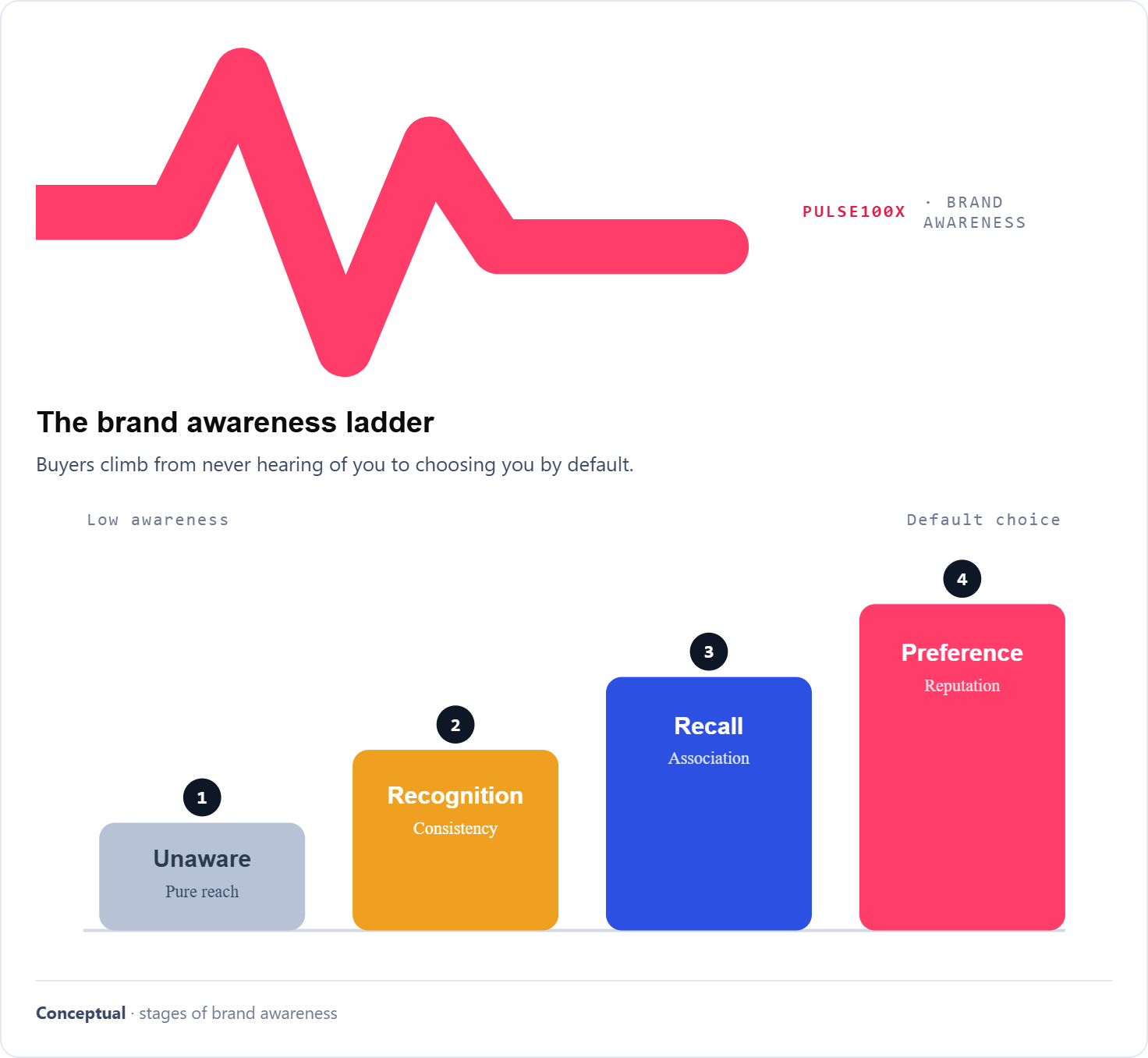
That preference is measurable and real. Statista research found that 63% of consumers are more willing to buy from brands they are familiar with, which makes awareness a direct input to the purchase decision rather than a soft metric.
Familiarity also lowers perceived risk. Faced with two options, a buyer treats the known brand as the safer choice, even without evidence it is better. Awareness quietly tips the default toward you before any feature comparison begins.
Why brand awareness drives growth
Awareness compounds because familiarity builds trust, and trust precedes purchase. People buy from brands they know, long before price or features enter the conversation. That trust works through a few clear mechanisms:
- Familiarity lowers perceived risk, so a known brand becomes the safer default.
- A recognized brand converts leads faster and cheaper than a stranger does.
- Repeated exposure builds the mental availability that surfaces your name at the moment of need.
The trust link is well documented. Edelman found that 81% of consumers say they must be able to trust a brand before buying from it, and Nielsen reports that 92% of consumers trust recommendations from people they know above any advertising.
Marketing scientists give this a name. The Ehrenberg-Bass Institute calls it mental availability, the probability a brand comes to mind in a buying situation, and argues it is the strongest lever for acquiring new customers over time.
There is also latent demand that awareness unlocks. Google's Liz Reid noted there are "billions of questions that people don't even ask," because they never think to. A known brand is the one that gets found when those questions finally surface.
The brand awareness ladder
Awareness rises in stages. Buyers move from never having heard of you to instinctively preferring you, and each rung needs different marketing to reach the next.
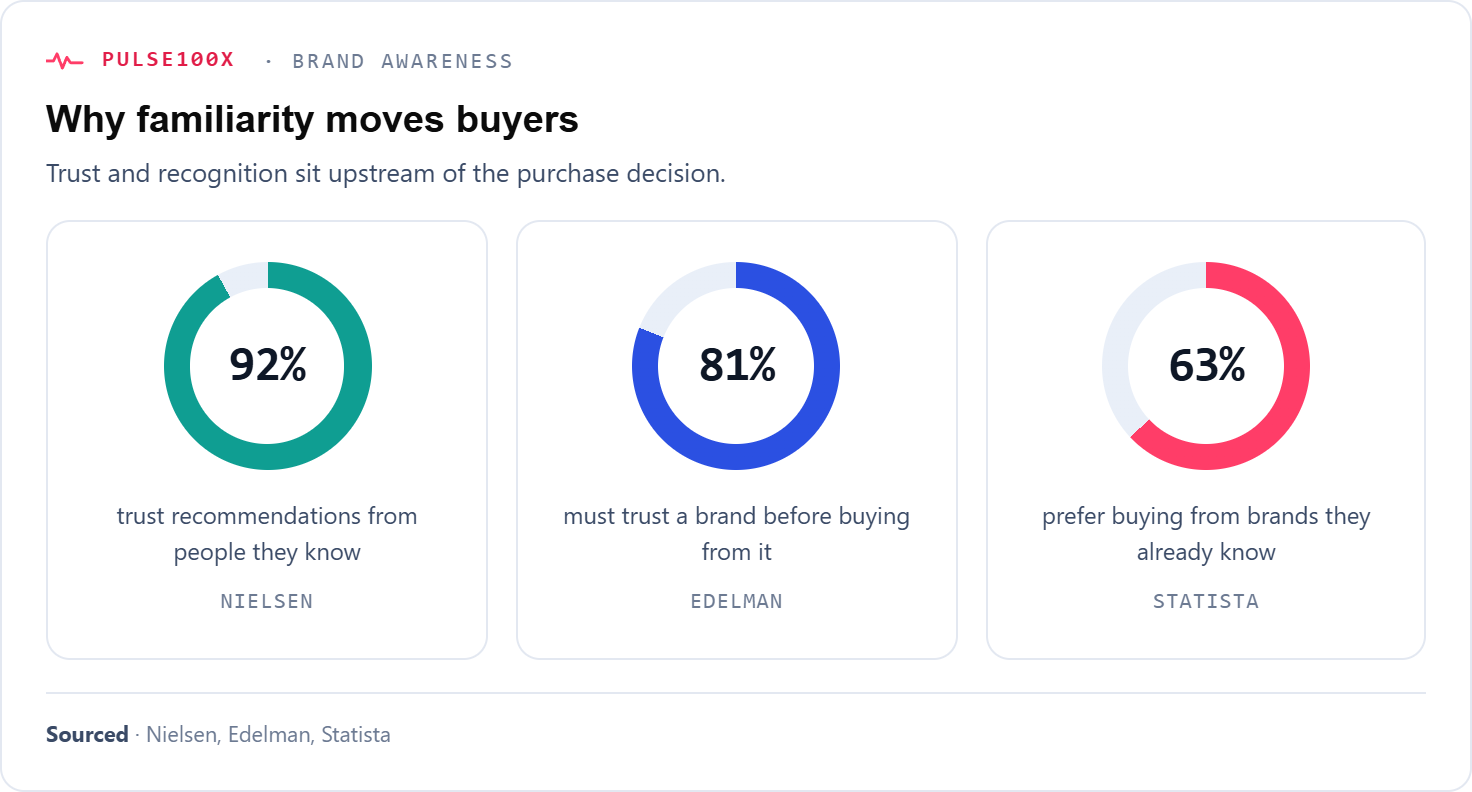
- Unaware. The buyer does not know you exist. The job here is pure reach, putting the brand in front of the right audience repeatedly.
- Recognition. The buyer knows your name when they see it. The job is consistency, so every touchpoint reinforces the same identity.
- Recall. The buyer thinks of you when the need appears. The job is association, tying your brand to a specific problem or moment.
- Preference. The buyer chooses you by default. The job is reputation, backed by experience that earns the loyalty awareness opened the door to.
Most brands over-invest at the bottom, chasing conversions from people who barely recognize them. Growth comes from feeding the top of the ladder so a larger pool is climbing toward preference at any given time.
This is why awareness and performance work together on the budget. A wide, warm top of funnel makes every lower-funnel campaign convert better, because the audience arrives already recognizing the brand instead of meeting it for the first time at the point of sale.
Requirements for building brand awareness
Awareness is built by being consistently visible where your audience already is, over a long enough period for familiarity to form. The tactics below compound when run together.
No single tactic builds a brand. Awareness comes from the overlap of many touchpoints reinforcing one identity, so the plan matters more than any individual channel within it.
- Publish genuinely useful content on the topics your audience searches, so discovery happens at the exact moment a need appears rather than when you happen to be advertising.
- Own organic search visibility for your category, since ranking for relevant queries is repeated, unpaid exposure that keeps working long after the work is done.
- Keep visual and verbal identity consistent everywhere, because distinctive, repeated assets like color, logo, and tone are what human memory actually latches onto.
- Earn media and partnerships that borrow the trust of audiences you have not reached yet, letting an established brand vouch for you by association.
- Show up steadily on the social platforms your buyers use, prioritizing consistent presence over the occasional viral moment that fades as fast as it spikes.
- Turn satisfied customers into advocates, since a personal recommendation carries a level of trust no paid message can manufacture.
The through-line is repetition with consistency. A brand seen once is forgotten, while a brand seen repeatedly, saying the same thing in the same voice, becomes familiar, and familiarity is the whole game.
Consistency is also what makes a smaller budget work. A brand that shows up the same way in a few places beats one that scatters mixed messages across many, because memory rewards the signal it sees repeated and forgets the loud one-off.
The channels that build awareness
Different channels build awareness in different ways. A strong program uses several, matched to where the audience spends attention, rather than betting everything on one.
Organic search and content
Ranking for category queries puts your brand in front of buyers actively researching. It is compounding exposure, and it increasingly feeds AI answers too, which makes answer engine optimization part of any modern awareness plan.
Social and community
Social platforms build familiarity through repeated, low-friction exposure. The goal is steady presence over constant selling, so your brand becomes a familiar face in the feed.
Earned media and PR
Coverage, mentions, and partnerships lend you the credibility of an established audience. A single feature in a trusted publication can introduce your brand to more of the right people than months of paid effort.
Paid amplification
Paid channels accelerate reach when organic alone is too slow. Used for awareness rather than only conversion, they widen the top of the funnel that lead generation later harvests, which is why digital lead generation works better when awareness precedes it.
How to measure brand awareness
Awareness feels intangible, but it leaves tracks. The trick is to watch leading indicators rather than wait for a survey once a year.
The aim is a dashboard the trend can defend. When you can point to rising branded search and growing share of search, awareness becomes a line item a client or board will fund.
- Branded search volume, the number of people searching your name directly, is the clearest signal awareness is rising.
- Share of search, your branded queries as a percentage of the category, tracks your position against rivals over time.
- Direct traffic and social reach show how many people arrive already knowing you.
- Engagement and mention volume reveal whether the audience actively talks about you, a deeper signal than passive views.
Watch these as trends rather than snapshots. A single month says little, but a steady rise in branded search and share of search over two or three quarters is the clearest proof an awareness program is working.
Fold these into your digital marketing KPIs and awareness stops being a feeling and becomes a trend you can defend to a client or a board.
Where brand awareness fits in the wider strategy
Awareness is the foundation the rest of the funnel is built on. Without it, lead generation fights uphill against strangers, and conversion rates stay capped by a lack of prior trust. Fund it as infrastructure and every downstream stage gets easier, from the first click to the final sale.
It belongs inside the plan itself. A coherent marketing strategy framework treats awareness as the top-of-funnel engine that feeds every stage below, so it keeps running instead of being a campaign launched once and forgotten.
The brands that treat awareness as ongoing infrastructure, sustained well past launch day, are the ones that stay top of mind. Familiarity decays without reinforcement, so the work becomes a habit with no end date.
Two inputs keep the plan honest:
-
A digital competitor analysis shows how visible rivals already are and where the attention gaps you can claim actually sit.
-
Leading indicators like branded search confirm whether the awareness work is moving the needle over time.
Build brand visibility that compounds
Pulse100x provides white-label content and SEO for agencies, so you grow client brand awareness while we handle the search visibility and execution.