How to Read an AI Visibility Report: Mentions, Citations and Share of Voice
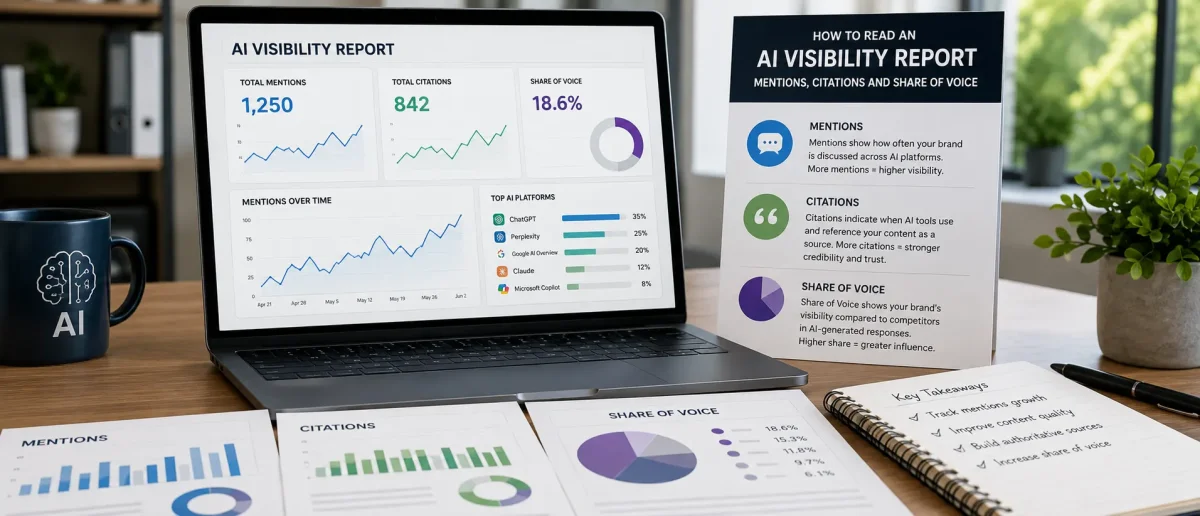
Open an AI visibility report for the first time and the numbers can look decisive. Mentions, citations, and share of voice resemble search rankings, but they measure something different.
An AI visibility report shows how a brand appears across AI-generated answers for a defined set of prompts. The useful part is not the headline number alone. It is understanding which prompts produce visibility, how competitors compare, and whether the appearances have commercial value.
What Is an AI Visibility Report?
An AI visibility report measures how often and how well a brand appears across AI-generated answers for a defined set of prompts. It records brand mentions, citations, competitive visibility, and other signals across selected AI platforms.
The results represent a sample rather than a fixed ranking. Answers can change across prompts, platforms, locations, languages, and reporting periods. A useful report therefore states the prompts, platforms, sample size, and period behind its findings.
The Key Metrics in an AI Visibility Report
Three metrics carry most of the meaning. They answer different questions, so none should be treated as a standalone score.
AI mentions
An AI mention occurs when an AI answer names the brand, product, or service. The mention can be positive, neutral, or negative and may appear in an explanation, comparison, recommendation, or list.
A mention confirms presence, not preference. A brand mentioned once in a buying recommendation may have more valuable visibility than one mentioned repeatedly in generic informational answers.
AI citations
An AI citation occurs when an AI system references or links to a source supporting its answer. A simple distinction helps: a mention is the AI talking about you, while a citation is the AI using a source to support what it says.
Citation behaviour differs between platforms, and some systems expose citations more clearly than others. Read citation data within the same platform and reporting method rather than treating every citation as directly comparable.
AI share of voice
AI share of voice measures a brand's visibility against competitors across a defined prompt set. It shows how much of the tracked category conversation the brand captures compared with named rivals.
A high share of voice does not automatically indicate higher revenue. The commercial value depends on where that visibility occurs, how the brand is represented, and whether the prompts reflect meaningful buying decisions.
Other AI Visibility Metrics You Should Understand
Mentions, citations, and share of voice show whether and how much a brand appears. Supporting metrics explain where that visibility comes from, what influences it, and whether it is worth pursuing.
Visibility / Presence Rate
Shows the percentage of tracked prompts where the brand appears at least once. A rising rate indicates broader coverage, but it should still be segmented by query intent.
Position / Placement
Shows where the brand appears within an AI answer, such as the first recommendation, a later mention, or a comparison list. Earlier placement can indicate stronger prominence when the platform makes position measurable.
Sentiment
Measures whether the brand is described positively, neutrally, or negatively. A visibility increase is not necessarily an improvement if negative or critical descriptions are driving the growth.
Citation Rate
Shows how frequently tracked AI answers cite the brand's website or associated sources. A low citation rate alongside strong mentions can indicate that the brand is being discussed without becoming a source of information.
Competitor Visibility
Shows which competitors appear for the same prompts and how frequently they are represented. Comparing this with your own visibility can reveal categories, intents, or topics where rivals have established stronger AI presence.
Prompt Coverage
Measures how widely the brand appears across the tracked prompt set. High coverage across different intents is generally more useful than concentrated visibility around a small group of branded or repetitive queries.
Source Distribution
Shows which websites, publications, directories, and other sources AI systems rely on when generating answers. It can reveal which third-party sources influence your brand's representation and where citation or digital PR opportunities may exist.
Taken together, these metrics explain the quality, breadth, context, and sources behind AI visibility. That makes them more useful for deciding what to improve than simply adding more metrics to a dashboard.
How to Read an AI Visibility Report Step by Step
Start with the reporting baseline, then move from visibility to competitive context and finally to action.
Step 1: Check the Reporting Period
Confirm the date range, prompt count, platforms, locations, and language before comparing results with another period.
Step 2: Check Your Overall Visibility
Compare the current period with the previous one to identify whether visibility is increasing, declining, or remaining stable.
Step 3: Look at Mentions
Find the prompts where the brand appears, where it is absent, and which competitors appear instead. Then assess the context of each mention.
Step 4: Analyze Citations
Identify which pages and external sources are being cited. Pay particular attention to commercial and comparison prompts where competitors may have stronger source coverage.
Step 5: Analyze Share of Voice
Compare the brand with named competitors and the category leader. Share of voice only becomes useful when the competitive reference point is clear.
Step 6: Analyze the Prompts
Group results by intent: informational, commercial, transactional, branded, and comparison. Visibility for "what is SEO?" carries a different business value from visibility for "best SEO agencies."
Step 7: Identify Content Gaps
Find prompts where competitors appear and the brand does not. Review the sources behind those answers to identify gaps in content, authority, or brand representation.
Step 8: Turn Insights Into Actions
Turn each meaningful gap into a hypothesis, an action, and a measurement point for the next reporting period.
Important note. A citation pattern can hide the real opportunity. If a competitor is cited for "best SEO agencies" while your site appears only for "what is SEO," the brand may have informational authority without strong commercial visibility. That gap is more useful than the overall score because it points directly to what needs attention.
How to Tell If Your AI Visibility Is Good
There is no universal good AI visibility score. The right benchmark depends on the category, competitors, prompt set, and business objectives.
Strong AI visibility generally means:
- Presence on high-value commercial and comparison prompts
- Share of voice that is competitive with the category leader
- Citations from relevant and authoritative sources
- Positive or neutral brand representation
- An improving trend across consistent reporting periods
A headline figure should therefore be read against named rivals and relevant queries, using the same competitor analysis discipline applied to other competitive channels.
Why High AI Mentions Don't Always Mean Strong AI Visibility
Mention volume alone can hide weak visibility because not every appearance has the same value.
|
Brand |
Mentions |
Where they appear |
|
Brand A |
100 |
Mostly generic and informational queries |
|
Brand B |
50 |
Commercial, comparison, and recommendation queries |
Brand B may have stronger visibility despite fewer mentions because its appearances occur closer to a buying decision. Prompt intent and context therefore matter alongside volume.
How to Improve Your AI Visibility Report Scores
Improving AI visibility means strengthening the signals that help AI systems understand, discover, and reference a brand.
- Strengthen commercial content so pages answer the questions buyers ask before choosing a product or service.
- Clarify entity representation so AI systems can understand what the brand offers, who it serves, and how it differs from competitors.
- Earn authoritative third-party coverage through digital PR and other activities that place the brand on sources AI systems already trust.
- Fix technical crawlability so useful content can be discovered and referenced.
By the numbers: A 2026 Muck Rack analysis found that 84 percent of AI citations come from earned media rather than a brand's own pages. Third-party coverage therefore deserves attention alongside owned content when citation growth is the goal.
Several of these improvements overlap with established SEO practices. The crawlable, well-structured content examined in a technical SEO audit remains a foundation for AI visibility.
AI Visibility vs Traditional SEO Metrics
AI visibility and traditional SEO measure different surfaces of the discovery journey. SEO focuses on ranked search results, while AI visibility measures presence within generated answers.
|
Traditional SEO metrics |
AI visibility metrics |
|
Rankings, clicks, impressions |
Mentions, citations, share of voice |
|
Search results pages |
AI-generated answers |
|
Relatively stable per query |
Varies by prompt, platform, and period |
|
Ranked position |
Sampled presence |
AI visibility complements search reporting rather than replacing it. This is why agencies can consider SEO, AEO, and GEO together when evaluating how clients are discovered.
How Agencies Can Use AI Visibility Reports for Clients
For agencies, the report can turn AI search into a measurable part of client strategy and reporting.
- Establish a baseline and track change over time
- Benchmark visibility against named competitors
- Identify content, prompt, and citation opportunities
- Connect AI visibility with broader marketing KPI reporting
- Prioritise prompts with the strongest commercial relevance
The report becomes more useful when each reporting cycle connects a visibility change to a specific action rather than presenting another score without context.
Turn AI visibility reports into client results
A report creates value when its findings lead to action. Agencies can use AI visibility data to identify commercial gaps, improve content, strengthen citation opportunities, and demonstrate progress over time.
Pulse100x provides White Label Digital Agency Services for agencies that need AI visibility reporting and execution across commercial content, entity optimisation, and digital PR.
Explore our SEO, AEO and GEO services to make AI-search visibility a measurable part of your client offering.