SEO Vs AEO Vs GEO: A 2026 Workflow Guide For Marketers
The fragmentation is structural, not cyclical. Google's AI Overviews now surface on 25.11% of all searches, up from 13.14% in March 2025 per Semrush 2026, and the same query routed through ChatGPT, Perplexity, and Gemini produces three different answer sets drawn from three different citation pools per Yext 2026 cross-engine analysis. A content asset built for classical SEO alone now competes for the shrinking slice of organic discovery the three answer surfaces have not yet absorbed, while assets formatted for all three surfaces compound across all of them.
What Do SEO AEO And GEO Actually Mean Today?
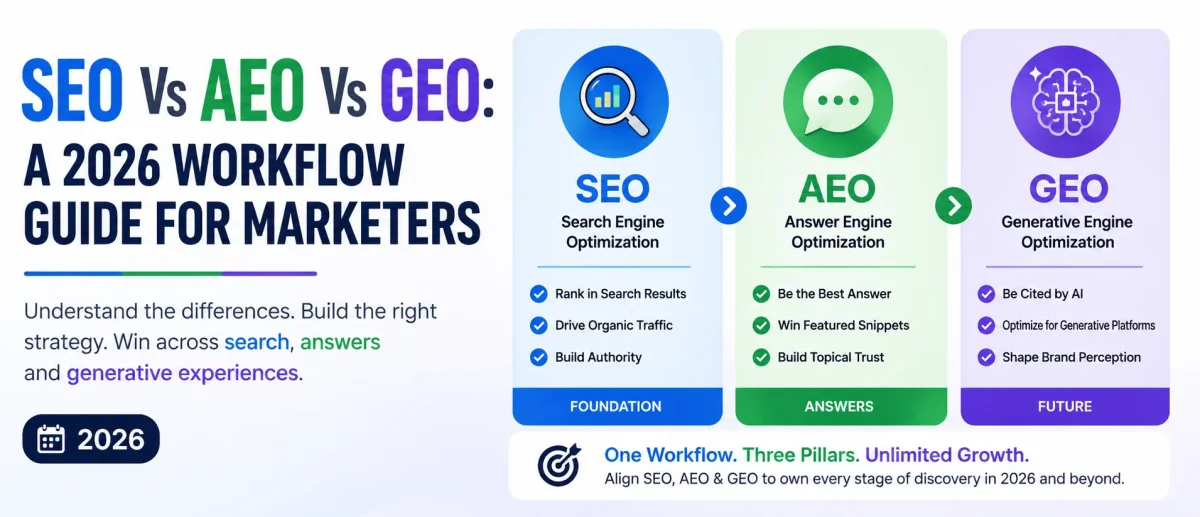
SEO is search engine optimisation focused on ranking pages in Google and Bing organic results to drive clicks. AEO is answer engine optimisation focused on having content selected as the direct answer inside AI Overviews, voice assistants, and featured snippets. GEO is generative engine optimisation focused on getting content cited inside responses produced by large language model platforms.
The three disciplines share the same content foundation but diverge in formatting, structural requirements, and success metrics. SEO measures ranking and click-through rate. AEO measures appearance share in AI Overviews and snippets. GEO measures citation share inside generative responses. A content asset that wins all three is built with all three formatting layers baked in from the brief stage.
The economics differ too. SEO is judged by traffic volume. AEO is judged by visibility share even when click-through falls because users get answers without visiting. GEO is judged by citation share and the high-intent traffic that does click through. Ahrefs 2025 measured AI search visitors converting at twenty-three times the rate of traditional organic, which makes GEO high-leverage even at modest volume.
How Does Classical Search Engine Optimisation Work In 2026?
SEO is the longest-established of the three disciplines and the one most marketers know best. It is the practice of optimising web content to rank in the organic blue-link results of search engines, with the objective of earning a click. The mechanics combine keyword targeting, on-page structure, technical health, content quality, and off-page authority signals.
The benchmarks have shifted in ways that change the economics. Position-one organic click-through rate fell from 1.41% to 0.64% on pages where an AI Overview appears, based on a 300,000-keyword 2025 study referenced across AI SEO aggregations. Ranking number one is no longer the same prize it was five years ago when AI Overviews did not exist.
SEO remains the foundation. URLs ranking in the traditional top ten remain the URLs most often cited inside AI Overviews, with overlap reported at 76.1% in early 2025 and dropping toward 38% on recent samples as AI engines diversify sources. The overlap is high enough that no AEO or GEO programme replaces SEO; the drop is significant enough that none can be safely substituted by SEO alone.
What Is Answer Engine Optimisation And Why Use It?
AEO is the practice of optimising content so that AI-driven answer surfaces select it as the direct answer to a user query rather than as one of many ranked options. The surfaces that matter are Google's AI Overview, Bing Copilot, voice assistants on Siri and Google Assistant, and the featured snippet box. The unit of optimisation is the answer paragraph or table, not the full page.
The mechanics of AEO differ from classical SEO in three specific ways that change how writers and editors approach the work.
-
A 40 to 60 word direct-answer block at the top of each section is the format AI Overviews preferentially extract and surface.
-
Structured data markup matters more than it does in classical SEO, since schema gives answer engines the scaffolding to surface a passage confidently.
-
Conversational language and natural question phrasing outperform keyword-stuffed phrasing, because answer engines model queries as full sentences.
-
Headers phrased as complete questions outrank the same headers phrased as keyword fragments in most AEO performance analyses.
-
Tables of comparison data are directly eligible for table snippet extraction and should be used wherever the data supports it.
The trade-off worth naming openly is that AEO success can correlate with lower direct traffic, because the user gets the answer without visiting the source page. The compensating benefit is brand authority and citation share, both of which feed downstream brand search and direct visits over time.
How Does Generative Engine Optimisation Drive AI Citations Today?
GEO is the practice of optimising content so that generative AI systems including ChatGPT, Claude, Perplexity, Gemini, and emerging agentic platforms cite it inside the responses they generate. GEO is the youngest of the three disciplines and the most rapidly evolving, because citation behaviour itself changes every quarter as underlying models retrain and retrieval systems reconfigure across major platforms.
Why Citation Behaviour Differs Today
GEO content is structured to be referenced rather than ranked. The goal is for a generative engine, when asked a question, to pull the content into its response as a cited source. Wikipedia accounts for 7.8% of ChatGPT citations across measured queries, with Reddit at 1.8%, Forbes at 1.1%, and G2 at 1.1%, per 2026 AI search statistics aggregations. Business and service sites collectively account for roughly 50% of all sources ChatGPT cites, which means brand sites with substantive content do appear in generative responses when the content is structured for citation.
What Makes Content Citable Today
Citation-friendly content shares a set of recognisable traits across the three major generative platforms. Every numerical claim is paired inline with the source name and the year, since generative engines preferentially cite passages with explicit sourcing. Named author and named reviewer credentials sit on the page, since AI engines weight author authority in citation decisions. Last-reviewed date is visible and recent, since engines prefer current information for time-sensitive queries over older comparable pages from the same domain.
How Conversion Behaviour Pays Off
AI search visitors who do click through from a generative engine response convert at a rate Ahrefs measured at twenty-three times the rate of traditional organic search visitors in 2025. The volume is smaller, but the quality is dramatically higher because users have already partly qualified themselves through the AI conversation before clicking. The implication is that GEO is a high-leverage discipline even when the absolute traffic numbers look modest compared to classical SEO funnel volumes.
Where Do SEO AEO And GEO Actually Overlap Today?
The three disciplines share the same content foundation. They diverge in the formatting, the structure, and the success metric. A useful way to picture the relationship is three layers built on a shared base, where each layer adds specific formatting requirements without replacing the layer underneath.
|
Discipline |
Focus |
Format unit |
Success metric |
|
SEO |
Ranking in traditional results |
The page |
Position and CTR |
|
AEO |
Being the direct answer |
Answer paragraph or table |
AI Overview presence |
|
GEO |
Being cited in generated responses |
Citable claim or statistic |
Citation share inside answers |
|
AAO |
Being chosen by AI agents |
Structured action endpoint |
Agent selection rate |
The overlap is substantial. Content that ranks well in classical SEO usually appears in AI Overviews, and content that appears in AI Overviews is usually citable by generative engines. The divergence shows up at the margin, where small formatting changes produce large differences in which surface picks up the content. A page that ranks position one on Google but has no FAQ schema and no answer-first paragraphs typically loses the AI Overview slot to a lower-ranking competitor that does have those elements in place.
AAO (AI Agent Optimisation) is the next discipline that builds on AEO and GEO. The transition under way in 2026 is from AI engines answering questions to AI agents taking actions on behalf of users. Yext 2026 notes that brand data needs to be structured, real-time, and machine-readable for an agent to confidently select the brand inside an automated workflow.
How Do Writers Build Content For All Three Disciplines?
The most useful question for a practitioner is not what the disciplines are but what changes in the workflow when writing for all three. The list below covers the concrete changes that show up in the brief, the draft, and the publication step of any modern content production cycle. Each H3 below names one of those three workflow stages.
Briefing Differences You Must Plan
The brief for an SEO-only post focuses on keyword research, search intent, and competitor analysis. The brief for an AEO and GEO ready post adds two more layers.
-
Identify People Also Ask questions the post must cover, since each PAA is a candidate citation slot.
-
Identify citable statistics the post references, since GEO favours pages with named, sourced, year-stamped figures.
-
Identify the schema markup the post will use, since structured data is the scaffolding for direct AI extraction.
Drafting Differences To Apply Consistently
The draft for a traditional SEO post can build to its answer over several paragraphs. The draft for an AEO and GEO ready post leads with the answer in every section without exception.
-
Every H2 intro opens with a 40 to 60 word direct answer to the section question.
-
Every H3 intro opens with the definition or core claim in its first sentence.
-
Every numerical claim is paired inline with the source name and year cited.
-
Every comparison is structured as a table where the data supports it directly.
Publication Differences To Get Right
The publication step for traditional SEO covers meta title, meta description, and on-page structure. AEO and GEO add three more publication-stage requirements that change which CMS templates are usable.
-
FAQPage schema on the FAQ section with each question and answer marked up correctly.
-
Article schema with named author, named reviewer, and last-reviewed date populated.
-
Open Graph and Twitter card markup, since social signals feed retrieval-augmented systems.
How Should You Pick An AEO And GEO Execution Model?
Teams approaching SEO, AEO, and GEO work in 2026 have several practical paths to execution, and the right one tracks how quickly the team needs presence in AI Overview and generative engine surfaces. The options below cover the realistic shapes most marketing and agency leaders evaluate.
-
Build the capability in-house by hiring a senior SEO who has retrained for AEO and GEO, which works when the team has the content volume to justify the seniority.
-
Partner with a specialist agency that has invested in AEO and GEO workflows ahead of the broader market and can ship across all three disciplines.
-
Use a white-label partner that absorbs execution across SEO, AEO, and GEO under a single retainer (Pulse100x is one example for agencies and brands wanting the three disciplines bundled rather than split across vendors).
-
Start with classical SEO and add AEO and GEO formatting as content matures, which is the slowest path but the lowest cost in the short term.
Conclusion
SEO, AEO, and GEO are not competing disciplines. They are three formatting layers built on the same content foundation, each tuned for a different way users find information. Teams that win in 2026 integrate the disciplines into one workflow rather than treating them as sequential projects. The penalty for ignoring AEO and GEO is not visible in classical SEO reporting.
The trade-off worth naming is that AEO and GEO success can produce smaller absolute click volumes because some users get their answer without visiting. The compensating benefits are brand authority, citation share, and the twenty-three times higher conversion; measured on AI search visitors who do click through.