SEO Outsourcing Vs In-House SEO: A 2026 Decision Framework
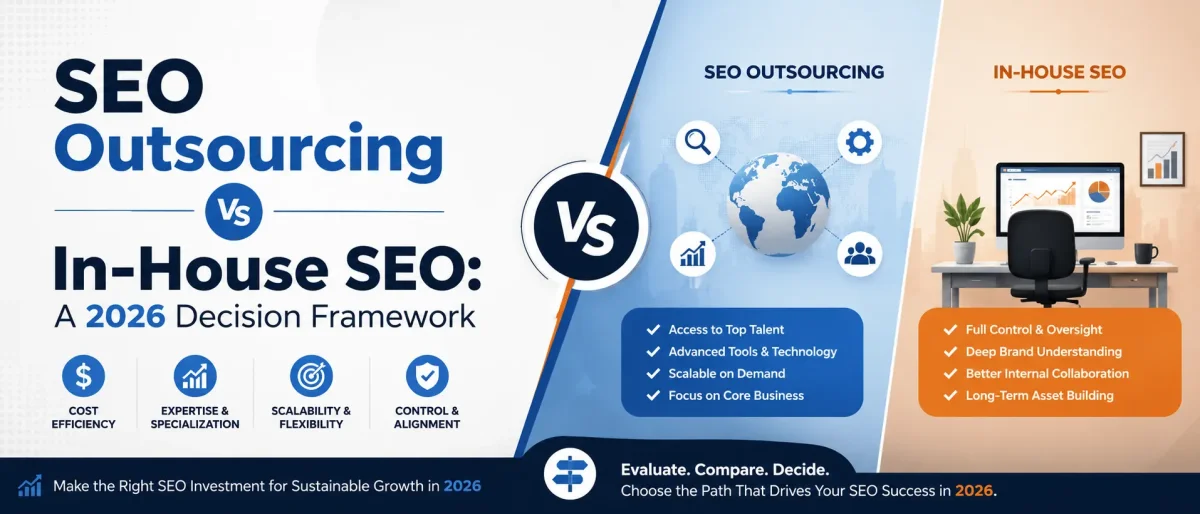
Roughly one in three companies that build an in-house SEO function below USD 5 million ARR unwind the hire within eighteen months, usually because the marginal contribution of a single SEO does not match the marginal salary cost at that scale. The reverse failure also happens: outsourced engagements selected on price alone tend to under-deliver against brand voice and end-client expectations, with brand voice drift surfacing in roughly 40% of agency engagements per Search Engine Journal's 2025 reader survey.
Read this blog to help with your decision on finalising which as per the scale of your operations.
What Defines In-House SEO And Outsourced SEO Models Today?
In-house SEO is the practice of building an internal function staffed by full-time employees who report inside the company's marketing organisation. Outsourced SEO is the practice of contracting an external team to deliver the same scope under a project, retainer, or dedicated-FTE arrangement. The deliverables are similar across both models. The cost structure, hiring path, and management overhead differ in ways that compound.
A mid-market in-house function typically includes a strategist, a technical specialist, a content writer, a link earning coordinator, and shared analyst access. Each role can be hired separately or collapsed into one multi-skilled person at smaller scale. The fully loaded cost includes salaries, benefits, payroll tax, training, conferences, and the tool stack. Most analyses underestimate the tool stack and training lines.
An outsourced engagement at equivalent scope replaces the team with an external partner that distributes the same roles across its own staff. The partner absorbs hiring, training, and tooling, and bills a flat retainer or hourly rate. The key operational difference is that partner bench depth means a sick day or resignation does not pause delivery, because redundancy is staffed by design across the client base.
How Much Does Each SEO Model Cost In 2026?
Outsourcing SEO is typically cheaper than building in-house at mid-market scope, but the published comparisons usually understate the in-house side by reporting only base salary. The fair comparison adds benefits, payroll tax, tools, training, and management overhead to the in-house side, and adds account management and tool top-ups to the outsourced side, before any model wins on cost alone in a defensible way.
- A mid-level in-house SEO specialist in the US costs USD 75,000 to USD 95,000 base, fully loaded to USD 95,000 to USD 130,000 once benefits and payroll tax are added, per RankAI 2026.
- A senior in-house SEO lead or director costs USD 110,000 to USD 180,000 base, fully loaded to USD 140,000 to USD 240,000 once benefits and payroll tax are added.
- The professional SEO tool stack including Ahrefs, Semrush, Screaming Frog, and a rank tracker runs USD 1,500 to USD 4,000 per month per team.
- Training, conferences, and certifications add USD 3,000 to USD 8,000 per team member per year on top of salary.
- An outsourced retainer covering content, on-page, links, and technical execution runs USD 5,000 to USD 15,000 per month for mid-market scope, per Semrush 2026.
- A dedicated FTE outsourced arrangement runs USD 1,500 to USD 3,500 per month for an India-based mid-level SEO specialist, per Invedus 2026.
- A four-person in-house SEO team with shared analyst totals USD 350,000 to USD 540,000 per year fully loaded, per Outpace SEO 2025 analysis.
- An outsourced engagement at equivalent scope totals USD 60,000 to USD 180,000 per year, per the same Outpace SEO 2025 cost-benefit analysis.
Which Trade-Offs Matter Most When Choosing Your SEO Model?
Cost is one axis. Speed, expertise depth, and control over the work are three more, and they often decide the outcome more than cost does. The trade-offs across these axes are where most decisions get made and where most get reversed twelve months later when the realities arrive. The sub-sections below walk through each axis with concrete examples.
Speed Of Execution In Practice
Outsourced SEO typically ships faster than in-house SEO in the first ninety days because the partner team has documented workflows for audits, content, and link earning that an in-house team would still be drafting. Semrush 2026 notes outsourced programmes show first leading-indicator movement within thirty to sixty days, while in-house teams launching from a cold start typically take ninety to one hundred and twenty days. In-house catches up after six months and then moves faster on cross-functional asks that require sitting next to product, sales, or customer-success teams.
Expertise Depth Across Both Models
Outsourced partners hold a structural expertise advantage because they work across forty to two hundred client accounts per quarter. The patterns they see, including algorithm signals, AEO and GEO behaviour, and competitive moves, are a knowledge surface no single in-house team accumulates at the same rate. The trade-off is that cross-account knowledge sometimes produces generic recommendations that miss the specifics of a single client's market. Mid-market companies rarely have the volume to develop true single-market depth in-house, which is why most rely on outsourced expertise even after building a small internal team.
Control And Brand Alignment Differences
Control is the axis where in-house SEO has the clearest advantage. The in-house team sits in the company's channels, attends product reviews, and absorbs brand voice through proximity rather than documentation. Brand voice drift on outsourced content is one of the most common complaints across Search Engine Journal 2025 reader surveys. The trade-off is that in-house teams over-fit to existing brand voice and under-experiment with formats that perform better in AI Overview and generative engine citation. Companies that prize voice strictness lean in-house; companies that prize experimentation velocity lean outsourced.
How Does Revenue Band Drive Your SEO Hiring Decision?
The decision is most defensibly made against revenue band, because revenue determines both the budget available for SEO and the volume of work the SEO function must absorb. The framework below holds across most companies in 2026 and aligns with recommendations from Outpace SEO 2025, SaaStorm 2026, and Authority Specialist 2026 in matching the model to the workload reality.
Early-Stage Companies Below USD 1M
The right answer for pre-revenue and early-stage companies is almost always outsourced SEO at the smallest viable scope. A USD 1,500 to USD 4,000 monthly retainer with a partner that handles technical setup, foundational on-page work, and a measured content cadence delivers more leverage than a USD 80,000 in-house hire that consumes a third of the marketing budget.
-
Outsourced partner handles strategy, on-page work, content, and reporting end to end.
-
Founder or one marketing generalist owns the partner relationship internally.
-
Tool stack is the partner's responsibility, not the company's expense line.
-
Scope expands as revenue allows, rather than being committed upfront.
Growth Stage SEO Hiring Approach
The growth-stage band is the messiest. Companies have enough revenue to justify a single in-house hire but rarely enough to justify a team. The right answer is usually a single in-house SEO lead paired with an outsourced execution layer that ships the work.
-
One in-house SEO lead owns the relationship to product, brand, and analytics.
-
Outsourced partner handles content production, link earning, technical work, and reporting.
-
The in-house lead spends one day weekly on partner management and four on cross-functional work.
-
Total annual cost typically lands at USD 180,000 to USD 280,000 fully loaded across the function.
Scale-Up SEO Hybrid Team Structure
Scale-up companies have the budget for a small in-house team, but most are still better served by a hybrid model that keeps execution outsourced. The hybrid preserves the cost discipline of the growth stage while adding senior strategic capacity inside the company.
-
Two to three in-house professionals: a director, an analyst, and a content partner.
-
Outsourced partner continues handling high-volume content production, link earning, technical work.
-
In-house director owns AEO and GEO strategy directly, since that is where competitive advantage builds.
-
Total annual cost typically lands at USD 320,000 to USD 480,000 fully loaded across the SEO function.
Enterprise Companies Above USD 50M
Enterprise SEO teams almost always run a full in-house function. The volume of work, the specialised vertical knowledge, and the cross-functional dependencies justify the cost at this revenue level. Most still maintain a contracted outsourced layer for spike capacity and specialist work such as international SEO, programmatic SEO, or AEO and GEO formatting at scale across multiple markets.
-
Four to ten in-house professionals across strategy, technical, content, and analytics layers.
-
Specialist outsourced partners on retainer for capabilities uneconomical to staff internally.
-
Annual SEO programme cost typically lands at USD 600,000 to USD 2,500,000 depending on scope.
-
In-house function owns the roadmap, with the outsourced layer providing scale and specialist capacity.
Why Does The Hybrid SEO Model Usually Win Today?
The hybrid model is the most common answer for companies in the growth and scale-up bands, and it is the model most often misimplemented in the field. It succeeds when the in-house lead owns strategy and the outsourced partner owns execution. It fails when the roles are reversed or when both parties try to own both axes simultaneously without a documented scope split.
Clean Hybrid Arrangement Structure Today
A clean hybrid has the in-house lead setting keyword strategy, owning the relationship to product and brand, and reviewing the partner's monthly content and link plans. The partner ships the work, reports weekly on progress and monthly on outcomes, and absorbs the operational load of writers, editors, technical implementers, and outreach teams. The in-house lead spends time on cross-functional work rather than writing meta descriptions or chasing link prospects.
Why Most Hybrids Fail Early
The failure mode that recurs most often is the in-house lead spending half their time on tasks the partner is contracted to do, usually because of low trust early in the engagement. Hybrids that document the scope split in writing during the first sixty days survive past twelve months. Hybrids that improvise the split drift toward one extreme and resolve into either a pure in-house or pure outsourced model within eighteen months without the company intending it.
How To Lock Split Early
The fix that holds across most growth-stage and scale-up companies is treating the scope split as a contract between the in-house function and the partner, signed off by both sides during the first sixty days. The split names which deliverables sit with the partner, which sit in-house, and where the review gates sit between them. Once documented, the split becomes the operational baseline; once improvised, it becomes the recurring source of friction.
How Should You Pick The SEO Model That Fits?
Companies facing this decision have a small number of practical paths, and the right one tracks revenue band and workload consistency more than personal preference. The options below cover the realistic shapes of the SEO function across mid-market and enterprise companies in 2026.
-
Build an in-house team and absorb the fixed cost, which works above roughly USD 50 million ARR with sustained predictable SEO volume across products or markets.
-
Outsource fully to a partner agency, which works below roughly USD 5 million ARR where one in-house hire would consume a third of marketing budget.
-
Run a hybrid where an internal lead owns strategy and an outsourced partner handles execution (Pulse100x is one example of a partner that handles the execution layer under a flat monthly retainer without contracts), which works between USD 5 million and USD 50 million ARR.
-
Use freelance specialists for occasional capability gaps, which works as a supplement rather than a primary model in any serious SEO programme.
-
Pick the model that fits the workload twelve months from now, not the workload this quarter.
Conclusion
The choice between SEO outsourcing and in-house SEO is not which model is universally better. It is which model fits the revenue band, workload volume, and strategic priority of SEO inside the marketing function. Companies that match the model to the band compound SEO returns over twenty-four to thirty-six month cycles. Companies that pick on comfort reverse the decision twelve to eighteen months later.
The 2026 reality is that the disciplines under SEO are also shifting, with AI Overviews surfacing on 25.11% of Google searches per Semrush 2026 and AEO and GEO emerging as distinct sub-disciplines. The hybrid model resolves most of the nuance for companies in the growth and scale-up bands.