What Is Generative Engine Optimization (GEO) and Why Agencies Should Sell It in 2026
A client can rank on the first page of Google and still disappear when a potential buyer asks ChatGPT which agencies, software platforms, consultants, or products to consider. The client has search visibility, but the AI answer has become another place where the shortlist is formed.
That is the problem generative engine optimization, or GEO, is designed to address.
GEO improves the likelihood that a brand is mentioned, cited, understood correctly, and represented positively in AI generated answers. The work overlaps with SEO, content, digital PR, technical optimisation, and entity building, but the output is different: instead of competing for a position on a search results page, the brand is competing to become part of the answer itself.
For agencies, that distinction creates a practical service opportunity. GEO can extend an existing SEO relationship into AI discovery without requiring an entirely separate marketing strategy. The agency can audit the client's current visibility, identify where competitors have an advantage, improve the underlying content and authority signals, and monitor whether those changes affect the prompts that matter to the business.
What Is Generative Engine Optimization (GEO)?
Generative engine optimization is the practice of improving how a brand appears and is represented in AI generated answers.
Traditional SEO is largely concerned with helping a page become visible when someone searches a query. GEO is concerned with what happens when an AI system interprets a prompt, gathers information from available sources, and generates an answer that may mention several brands.
That creates several optimisation questions that a traditional ranking report does not answer:
- Does the AI system mention the brand at all?
- Does it recommend the brand for relevant commercial prompts?
- Does it describe the brand accurately?
- Which competitors appear instead?
- Which websites does the system cite when supporting its answer?
- Does the brand's own website provide information that can be used as a source?
- Does the brand appear for high-value prompts or only broad informational questions?
The objective, therefore, is not to achieve a fictional "#1 ranking" inside ChatGPT. AI responses are probabilistic and can vary between prompts, platforms, sessions, locations, and time periods.
A useful GEO programme instead improves qualified AI visibility: the probability that a brand appears appropriately across the prompts that matter to its market.
Why Is GEO Important in 2026?
AI tools have moved from being experimental research tools to another way people discover information, compare options, and narrow down purchases. A prospect can ask an AI system to recommend accounting software, compare CRM platforms, shortlist an SEO agency, or explain which product is appropriate for a particular use case without starting with a conventional search query.
By the numbers: Google's AI Overviews reached roughly 2.5 billion monthly users by mid-2026, while ChatGPT passed around 900 million weekly active users in early 2026. Surveys have also reported that about 37% of consumers start searches with AI tools.
The important agency question is not whether every one of those users represents a new lead. It is where AI is entering the client's buying journey.
Suppose an agency manages SEO for a B2B software company. The company's product page ranks well for "CRM software," but a prospect asks an AI system, "What are the best CRM platforms for a 100-person sales team?" Five competitors appear and the client does not.
The SEO campaign may be performing well while the brand is still missing from an increasingly important consideration stage.
That is where GEO becomes commercially useful. It gives the agency a way to investigate why the client is absent, which sources influence the answer, what competitors are doing differently, and what work could improve the client's position.
For B2B brands, this matters even more because buying journeys often involve research long before a prospect fills out a form. AI visibility can influence which vendors enter the shortlist, even when the eventual conversion still happens through a website, sales call, or branded search.
How Does Generative Engine Optimization Work?
GEO works by improving the information and authority signals available to AI systems when they determine which brands and sources are relevant to a prompt.
There is no single GEO tactic that guarantees inclusion. The work usually combines several disciplines that agencies may already provide separately.
- Clear entity representation: Brand pages should make it easy to understand what the company does, which products it offers, who it serves, where it operates, and how its offerings relate to one another. Conflicting or vague descriptions make it harder for systems to build a consistent representation of the brand.
- Structured, quotable content: Pages should answer specific questions clearly instead of burying the useful information under long introductions and generic commentary. A concise definition, comparison, specification, or explanation gives systems usable information to draw from.
- Third-party authority: AI systems frequently rely on external sources when constructing answers. Relevant coverage, reviews, industry publications, directories, research, and other authoritative references can therefore influence how a brand is represented.
- Technical accessibility: Important pages still need to be discoverable and readable. GEO does not remove the need for crawlable websites, sensible information architecture, indexable content, and technically sound pages.
- Topical coverage: A brand that has one page about a subject but little supporting evidence elsewhere may have a weaker knowledge footprint than a competitor with comprehensive coverage across products, use cases, comparisons, and industry questions.
The practical lesson for agencies is that GEO is rarely a reason to throw away an existing SEO programme. In many cases, the agency is already doing part of the work. GEO changes what the agency measures and where it looks for gaps.
GEO vs SEO: What's the Difference?
SEO and GEO address different points in the discovery process, although their foundations overlap.
|
SEO |
GEO |
|
|
Primary target |
Search result visibility |
AI answer visibility |
|
User interaction |
Query → results → website |
Prompt → generated answer → sources → website |
|
Important signals |
Relevance, links, technical quality, content |
Entity clarity, relevance, citations, authority, content |
|
Core measurements |
Rankings, clicks, impressions, traffic |
Mentions, citations, share of voice, prompt coverage |
|
Variation |
Rankings can be relatively stable for a query |
AI responses can vary by prompt, platform, and time |
|
Agency output |
Search optimisation and traffic growth |
AI visibility, representation, source authority, and related optimisation |
The distinction matters when reporting results.
An SEO report might say that a page moved from position eight to position four and generated additional organic traffic. A GEO report might show that the brand appeared in 42% of tracked commercial prompts, up from 27%, while its share of voice increased against two named competitors.
Neither metric replaces the other.
A client can have excellent rankings but weak AI visibility. It can also gain AI visibility without seeing an immediate increase in website traffic because an AI answer may satisfy part of the user's research without a click.
That is why agencies should position SEO, AEO, and GEO as connected parts of discovery rather than presenting GEO as the successor to SEO.
What Are the Main GEO Strategies?
A useful GEO strategy starts with the client's visibility problem rather than with a predetermined list of tactics.
|
Strategy |
What it does |
When it matters most |
|
Entity optimisation |
Clarifies what the brand, products, and services are |
The brand is inconsistently described |
|
Content structuring |
Makes information easier to understand and reference |
Pages are vague, buried, or difficult to extract from |
|
Digital PR and citations |
Builds external evidence and authority |
Competitors are consistently supported by stronger sources |
|
Commercial page optimisation |
Improves relevance for buying-intent prompts |
The brand appears for information but disappears from recommendations |
|
Technical readiness |
Keeps important information accessible |
Key pages have crawlability, indexing, or rendering issues |
|
Topical coverage |
Builds depth around important category questions |
Competitors have stronger coverage across related topics |
The distinction between these strategies is important because the same visibility problem can have very different causes.
If a brand is mentioned frequently but rarely cited, publishing another ten blog posts may not solve the problem. The agency may need to improve the quality of the sources that discuss the brand.
If the brand is cited but only for informational questions, the problem may sit in commercial content. Product comparisons, service pages, use cases, pricing explanations, and buyer-focused content may need stronger coverage.
That diagnosis is where GEO becomes a genuine optimisation service rather than a renamed content package.
Why Agencies Should Sell Generative Engine Optimization in 2027
GEO gives agencies an opportunity to expand an existing search relationship into another discovery surface without asking the client to buy an unrelated service.
The commercial opportunity is strongest for agencies that already have access to the client's content, SEO data, technical environment, and authority-building programme.
Existing SEO clients already have much of the infrastructure
An SEO agency may already manage technical audits, content production, keyword research, internal linking, digital PR, competitor research, and reporting. Those capabilities provide a large part of the delivery foundation for GEO.
The agency does not need to build a completely separate operation. It needs to add AI visibility measurement, prompt analysis, source analysis, and GEO-specific recommendations to the workflow.
GEO creates new recurring work
A one-time AI visibility audit can identify the baseline, but AI answers change and competitors change with them. A client that treats AI discovery as an active channel can therefore justify ongoing prompt monitoring, competitor analysis, content optimisation, source tracking, and reporting.
That gives agencies a natural progression from audit to implementation to retainer.
GEO exposes gaps existing SEO reports can miss
A client may celebrate ranking improvements while competitors continue to dominate AI recommendations. Showing that gap creates a stronger commercial conversation than simply telling the client that AI is becoming important.
The agency can point to a specific prompt, competitor, source, or content gap and connect it to a defined piece of work.
GEO can increase the value of an existing account
A client does not necessarily need another agency relationship to address AI visibility. If the existing SEO agency can demonstrate the problem and already owns much of the implementation capability, GEO becomes an expansion opportunity within the current account.
What Should a GEO Service Include?
A sellable GEO service needs more than an AI visibility score. It needs a repeatable delivery process that tells the client where they stand, why they are there, what the agency will change, and whether the change worked.
|
Component |
Purpose |
|
AI visibility baseline |
Establishes current presence across a defined prompt set |
|
Competitor analysis |
Shows where competitors gain visibility |
|
Citation analysis |
Identifies which sources support competitor and brand answers |
|
Prompt analysis |
Separates informational, commercial, branded, and comparison visibility |
|
Entity and content optimisation |
Improves brand clarity and source usefulness |
|
Digital PR and citation building |
Builds relevant third-party authority |
|
Technical improvements |
Resolves accessibility and crawlability issues |
|
Ongoing monitoring |
Measures movement against the original baseline |
|
Reporting |
Connects visibility changes to commercial priorities |
The scope also needs operational boundaries.
An agency should define which AI platforms are included, how many prompts are tracked, which markets are covered, how often monitoring happens, how many content pieces are included, and whether technical or digital PR execution is part of the retainer.
Without those boundaries, a GEO service can quickly become unlimited SEO, content, and PR work sold under a new label.
How Agencies Can Package GEO Services
Packaging should reflect the amount of diagnosis and implementation required rather than simply offering three increasingly expensive versions of the same report.
GEO audit
The audit suits clients that know AI visibility matters but do not yet know where they stand.
It should establish the prompt universe, measure current brand and competitor visibility, analyse mentions and citations, identify the sources influencing answers, and separate content, authority, entity, and technical gaps.
The final deliverable should be a prioritised roadmap rather than a dashboard full of numbers.
GEO optimisation
This package is for clients ready to implement the recommendations.
Depending on the audit, the agency might restructure commercial pages, create or improve supporting content, clarify entity information, resolve technical issues, strengthen internal linking, or develop a third-party citation strategy.
The scope should be tied to deliverables and estimated production hours so the agency knows what the retainer can actually support.
Ongoing GEO retainer
An ongoing programme can include monthly prompt monitoring, competitor tracking, citation analysis, content recommendations, source monitoring, digital PR opportunities, reporting, and strategy calls.
The important distinction is that recurring GEO work should not become a monthly report with no optimisation behind it. If the agency tracks a visibility gap for six months without changing the inputs causing it, the client is paying for observation rather than improvement.
How to Price GEO Services
There is no meaningful universal GEO price because the delivery workload can vary dramatically between clients.
A small audit covering 50 prompts across two platforms requires a different amount of research and reporting from a monthly programme tracking hundreds of prompts across several platforms, countries, and product categories.
|
Model |
How it fits |
|
One-time audit |
Fixed prompt, platform, and analysis scope |
|
Project optimisation |
Defined content, technical, entity, or authority work |
|
Monthly retainer |
Recurring monitoring, optimisation, and reporting |
Agencies should estimate GEO pricing from the actual delivery inputs:
Prompt volume + platform coverage + market coverage + content workload + technical workload + authority building + reporting + account management
That approach also protects agency margins.
If a GEO retainer includes 20 new content pieces, monthly prompt tracking, digital PR outreach, technical implementation, and two strategy calls, it should not be priced like a lightweight reporting package simply because both are called "GEO."
Yes. The problem is that the first list is a metric inventory, not an interpretation framework. If the reader already knows what mentions, citations, and share of voice are, simply seeing nine metric names does not help them read a GEO report.
I’d make the first half answer what the metric tells you and what a particular pattern means. That also makes the later CRM example feel like a continuation rather than a separate thought.
How to Measure GEO Performance
GEO reporting needs to separate visibility from business performance. A brand can become more visible in AI answers without generating more traffic or leads, while a smaller increase on commercially important prompts may have greater business value.
The first layer answers where and how the brand is appearing in AI answers:
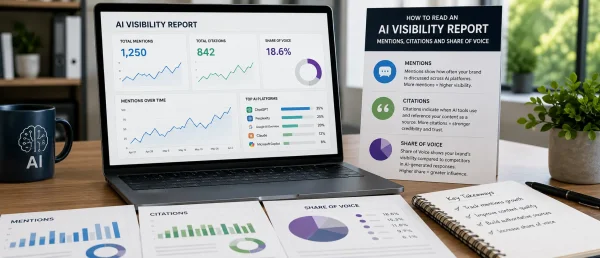
- AI visibility or presence rate: Shows how often the brand appears across the tracked prompt set. Read it against the same prompts and period over time, because a higher rate is only meaningful when the underlying sample remains consistent.
- Brand mentions: Shows how frequently AI answers name the brand. A high mention rate is useful, but check the prompts and context because mentions on informational questions may carry less commercial value than recommendations or comparisons.
- AI citations: Shows how often the brand's website or other associated sources are referenced. Strong mentions with weak citations can indicate that AI systems recognise the brand but rely on other sources to support their answers.
- Share of voice: Shows how much of the tracked AI conversation the brand captures compared with competitors. This is more useful than an isolated visibility score because it shows whether the brand is gaining or losing ground in the category.
- Prompt coverage: Shows how broadly the brand appears across the questions being monitored. A brand that appears repeatedly for a narrow group of prompts may have strong visibility within one topic but weak coverage across the wider buying journey.
- Competitor visibility: Shows which rivals appear when the brand does not. Comparing the missing prompts with competitor presence can reveal whether the gap is concentrated around particular services, use cases, or commercial questions.
- Position or placement: Shows where the brand appears within an answer when the platform provides a consistent way to measure it. Placement can help distinguish a passing mention from a prominent recommendation, although it should not be treated like a conventional search ranking.
- Sentiment and representation: Shows whether the brand is described positively, neutrally, negatively, or inaccurately. A visibility increase is not necessarily an improvement if the additional mentions contain outdated or incorrect information.
- Source distribution: Shows which websites, publications, directories, and other sources AI systems repeatedly draw on. This is particularly useful for identifying authority gaps because it tells the agency where competitors are earning the evidence that supports their visibility.
These metrics become useful when read together rather than as separate scores. For example, strong mentions combined with weak citations may point toward an authority problem, while strong visibility on informational prompts but weak visibility on comparison prompts may point toward a commercial content gap.
The second layer asks whether that visibility matters commercially:
- Organic traffic: Did changes in AI visibility coincide with changes in search traffic?
- Branded search demand: Did more people begin searching specifically for the brand or its products?
- Referral traffic: Are identifiable visits arriving from AI platforms or AI-generated links?
- Leads and calls: Are prospects taking measurable actions after discovering or researching the brand?
- Assisted conversions: Does AI visibility appear in journeys that eventually produce a conversion, even when it was not the final referral source?
- Revenue: Where attribution is reliable, does increased visibility contribute to actual commercial value?
The two layers should not be collapsed into one score.
Suppose a brand's AI mentions rise by 40%, but nearly all the increase comes from informational prompts such as "What is CRM?" while competitors still dominate "best CRM for mid-sized sales teams." The visibility number improved, but the commercial opportunity may not have moved.
A useful GEO report therefore breaks performance down by intent, competitor, platform, and prompt type. It should help the agency distinguish between a brand that is appearing more often and a brand that is appearing in the places where buyers are actually making decisions.
Where attribution is technically possible, the agency can then investigate the path from AI visibility to website visits and eventually to leads or revenue. Where attribution is not possible, the report should say so rather than imply that every conversion came from an AI answer.
That makes GEO reporting more credible alongside the client's marketing KPI reporting.
How to Sell GEO to Existing SEO Clients
The strongest GEO pitch begins with evidence from the client's own market.
Start by running a representative set of commercial, comparison, informational, branded, and problem-based prompts. Then compare the client's presence with the competitors that appear in those answers.
A practical sales sequence looks like this:
- Show the current AI visibility. Establish how frequently the brand appears and where it does not.
- Show competitor visibility. Identify which rivals consistently appear for the same prompts.
- Separate high-value prompts. Focus on recommendations, comparisons, category searches, and other queries connected to buying decisions.
- Analyse the citations. Show which publications, reviews, directories, or other sources support competitor answers.
- Identify the gaps. Determine whether the problem is content, entity clarity, authority, technical accessibility, or some combination.
- Attach work to each gap. Turn the diagnosis into a defined roadmap with deliverables and expected monitoring.
- Extend the SEO relationship. Position GEO as additional work built on the client's existing search foundation.
A grounded pitch might be:
Your website ranks strongly for the category, but competitors appear in 63% of the commercial AI prompts we tested while your brand appears in 29%. Most of their answers are supported by three industry publications and two comparison sites where your brand has little or no presence. We can address those gaps through content, authority building, and ongoing AI visibility monitoring.
That conversation gives the client a problem, evidence, a competitive comparison, and a proposed solution. It does not require the agency to predict the future of AI.
What Does a GEO Audit Look Like?
A useful GEO audit moves from measurement to diagnosis to prioritisation.
- Brand visibility baseline: Measure how frequently and where the brand appears.
- Prompt universe: Define the questions that represent the client's market and buyer journey.
- AI platform coverage: Establish which platforms are being monitored and why.
- Competitor visibility: Compare the client's presence with named competitors.
- Mentions: Analyse when the brand appears and how it is described.
- Citations: Identify which sources support the answers and where competitors have stronger evidence.
- Sentiment: Review whether brand representation is positive, neutral, negative, or inaccurate.
- Source analysis: Identify recurring publications, directories, reviews, and other influential sources.
- Content gaps: Find questions where competitors are represented but the client's owned content provides weak or missing information.
- Authority gaps: Identify external sources that influence answers but do not currently support the client.
- Technical gaps: Check whether important information is accessible, crawlable, and properly structured.
- Action roadmap: Rank opportunities by commercial value, effort, and likely strategic importance.
The audit should not end with "publish more content."
If a competitor appears because ten respected industry publications discuss its product while the client's website has twice as many blog posts, the obvious recommendation is not another content calendar. The agency needs to address the evidence surrounding the brand, which may require digital PR, reviews, partnerships, or stronger third-party coverage.
Technical findings can also be separated from strategic ones. A technical SEO audit may identify crawlability or rendering problems that prevent otherwise useful content from becoming a reliable source.
Common GEO Mistakes Agencies Should Avoid
Treating GEO as the replacement for SEO
Most GEO programmes still depend on the fundamentals agencies already know: accessible websites, useful content, clear entities, strong internal structure, and authoritative external references. Selling GEO as a clean break from SEO creates unnecessary confusion and makes the service harder to fulfil.
Reporting one visibility score
A single percentage can hide whether the brand appears for low-value educational prompts or high-value commercial recommendations. Reports should preserve the context behind the number, including prompt intent, competitors, platform, and period.
Promising deterministic AI rankings
AI systems do not behave like a conventional results page where an agency can promise position three for a specific keyword. A responsible GEO programme measures visibility across a defined sample and reports movement rather than guaranteeing a fixed placement.
Publishing content without improving authority
A larger owned content library does not automatically make a brand more visible in AI answers. If competitor answers are repeatedly supported by trusted third-party sources, the agency needs to examine the client's external authority rather than simply increase publishing volume.
Leaving the scope open-ended
GEO can easily absorb content, SEO, PR, technical development, analytics, and account management. Without limits around prompts, platforms, content volume, markets, reporting, and implementation, an apparently attractive retainer can become difficult to deliver profitably.
The Future of GEO and SEO
The distinction between search and AI discovery will probably become less useful as users move between both interfaces during the same buying journey.
A prospect might search Google for "best project management software," ask an AI system to compare the shortlisted products, visit third-party reviews, return to the vendor's website, and eventually speak with sales. The discovery path no longer belongs to one interface.
For agencies, that changes the strategic question from "Should we sell SEO or GEO?" to "Where does this client's audience discover and evaluate the brand, and how do we improve its visibility across those surfaces?"
That broader approach brings search, AI answers, content, digital PR, technical SEO, and entity management into one connected digital marketing strategy.
The platforms will change. The names of the AI products will change. The measurement methods will become more sophisticated. The durable agency capability is the ability to identify where a client is absent, understand which signals influence that absence, execute the required work, and measure whether the gap narrows.
Add GEO to your agency's offer without building it from scratch
GEO becomes a stronger agency service when it is treated as an operational extension of search rather than a standalone AI product. The opportunity is to measure a client's visibility, identify commercially relevant gaps, execute the required content and authority work, and report the movement over time.
Pulse100x provides White Label Digital Agency Services covering SEO, content, link building, local SEO, and AI search work under an agency's brand.
Its SEO, AEO and GEO services can provide the fulfilment layer while your agency owns the client relationship, strategy, scope, reporting, and commercial outcome.