What Is Keyword Mapping? A Step-by-Step Guide for 2026
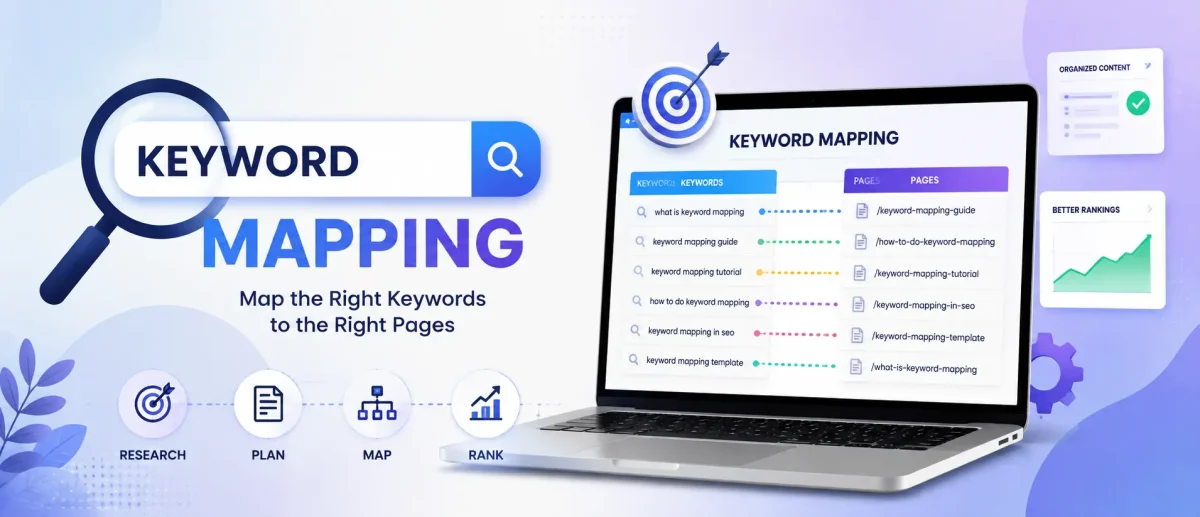
Keyword mapping fixes that. It is the deliberate act of assigning each target keyword to a single, best-fit page, then building the page around the intent behind it. Done first, it turns a pile of keywords into a plan.
What is keyword mapping
Keyword mapping is the process of matching each keyword, and the search intent behind it, to a specific URL on your site. The output is a document that pairs every priority term with the one page responsible for ranking for it.
It sits between research and writing. Research tells you which terms are worth chasing, and writing produces the pages, but mapping is the step in the middle that decides which page owns which term, so nothing gets built twice or aimed at the wrong query.
That one-to-one discipline is the point. Without it, a site publishes overlapping pages that split authority and confuse search engines about which URL to rank. With it, every page has a clear job and a clear query to own.
The map is also a communication tool. For every priority term, it records three things a writer needs:
- The primary keyword the page must own.
- The search intent the page has to satisfy.
- The secondary keywords to weave in for depth.
That removes the guesswork that produces off-target drafts and endless revision cycles.
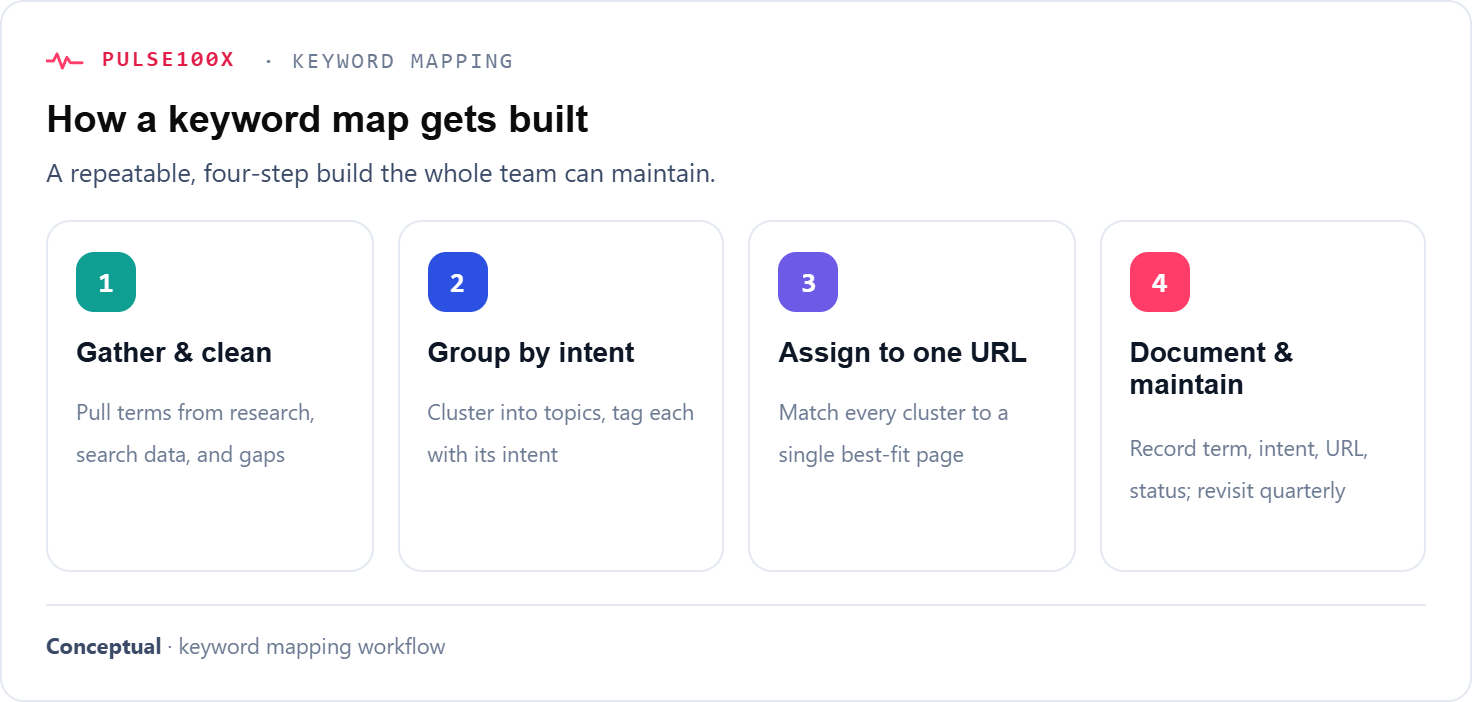
Understanding intent is what makes mapping work, and search engines have spent years learning to read it. Google's Pandu Nayak described its BERT model as "particularly useful for understanding the intent behind search queries," a shift that rewards pages built around meaning rather than exact words.
The scale of new language explains why. Google reports that 15% of daily searches are entirely new, never seen before, so a map built on rigid exact-match terms ages fast. Mapping to the intent behind a term keeps it durable as the exact wording keeps shifting.
Why keyword mapping matters
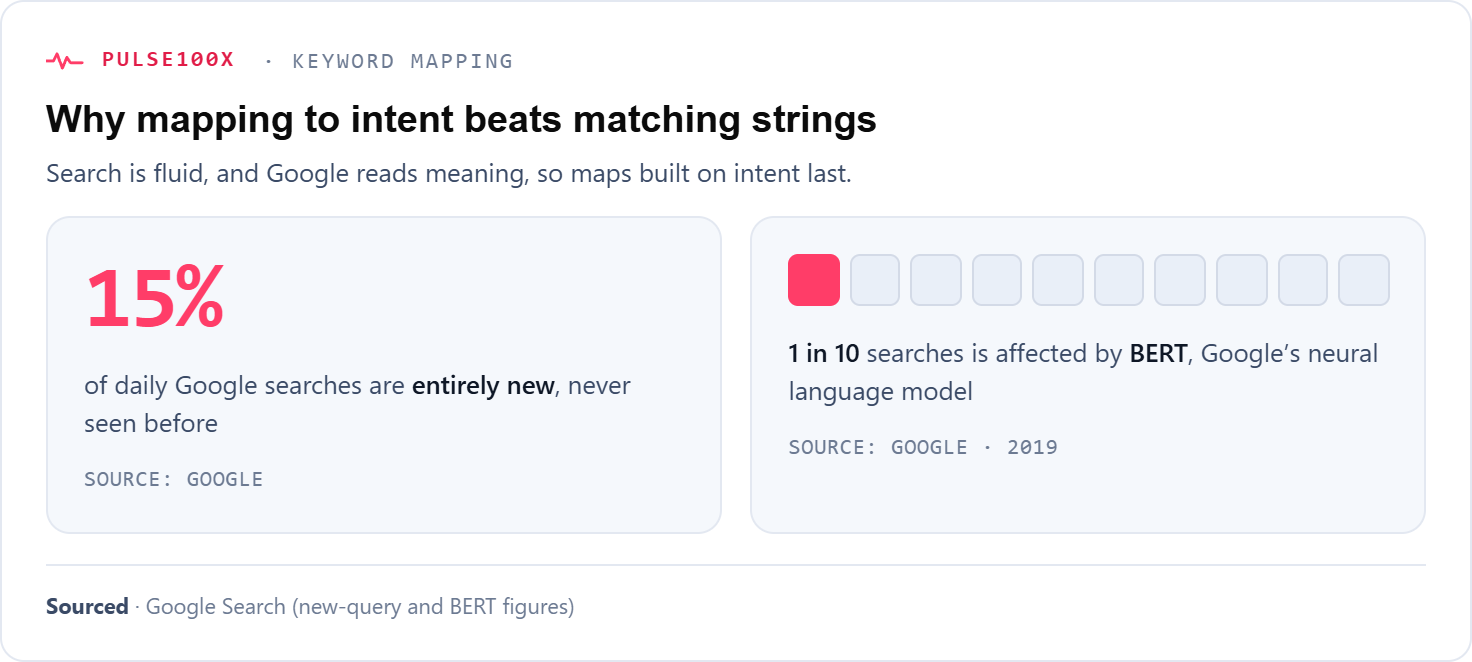
Skip the map and the symptoms are predictable. The most common is keyword cannibalization, where multiple pages chase the same term and dilute each other, leaving all of them weaker than a single focused page would be.
Cannibalization is quietly expensive. Two pages splitting the authority for one term often both stall on page two, when a single consolidated page would have had the strength to reach page one on its own.
Beyond cannibalization, a finished map earns its place in three concrete ways:
- It exposes gaps, since every target keyword with no matching URL reveals exactly what to create next, turning a vague backlog into a prioritized list.
- It protects internal structure, because each page owns a primary term, so links and anchors point where they should and the site reads as an organized hierarchy.
- It scales local coverage, mapping local keywords to the right city or service pages so white-label local SEO gives each area one clear page instead of several thin ones competing.
That gap view also makes budgeting honest. An agency can point to the specific unmapped clusters worth the most traffic and build toward them in order of value.
The four search intents behind keywords
Every keyword carries an intent, and mapping to the wrong one wastes the page. Search engines now classify intent with machine learning, so aligning the page to it is non-negotiable.
Get the intent right and the format, depth, and calls to action all follow from it naturally. There are four broad categories to work with.
Informational
The searcher wants to learn. Queries like "what is keyword mapping" seek an explanation, best served by a guide or article. These sit at the top of the funnel and build awareness rather than drive immediate sales.
Navigational
The searcher wants a specific site or brand. Queries like "Google Search Console login" are headed somewhere precise, so ranking usually means being that destination rather than competing for the term.
Commercial
The searcher is comparing before buying. Queries like "best project management software" want reviews, comparisons, and lists. These pages nurture the decision and sit close to conversion.
Transactional
The searcher is ready to act. Queries like "buy running shoes online" want a product or checkout page. Mapping an article here, instead of a commercial page, is a classic and costly mismatch.
Google's ability to read these has been building for a decade. RankBrain, launched in 2015 as its first deep-learning ranking system, began interpreting the meaning behind queries rather than matching keywords literally, and every model since has deepened that reading.
How to build a keyword map, step by step
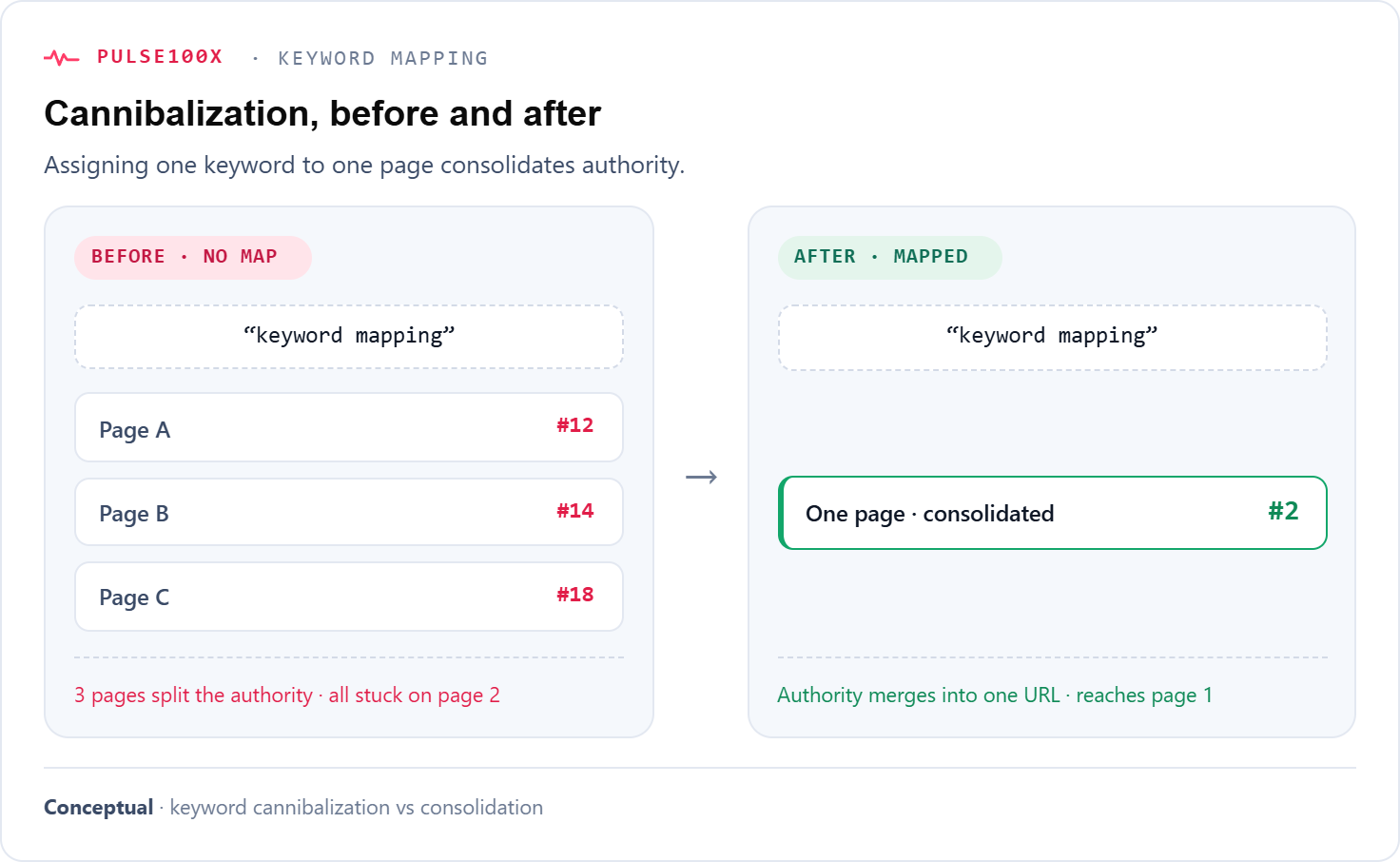
A keyword map is a repeatable build. The steps below produce one that a whole team can maintain, and they run in order because each depends on the last.
Step 1 - Gather and clean the keyword list
Pull keywords from research tools, search data, and competitor gaps. Remove duplicates and irrelevant terms, then keep the ones that match your audience and business, so the map starts from signal rather than noise.
Step 2 - Group by topic and intent
Cluster the surviving keywords into topic groups, then tag each with its search intent. This clustering is what prevents one-page-per-keyword bloat and reveals which terms belong together on a single URL.
Step 3 - Assign each cluster to one URL
Match every cluster to an existing page or flag it for a new one. Assign a single primary keyword per page, with secondary terms supporting it, so no two pages compete for the same query.
Step 4 - Document and maintain the map
Record it in a shared sheet with keyword, intent, URL, and status. Revisit it as the site grows and as new queries appear, treating the keyword map as a living document you keep current.
- Keep one primary keyword per URL to prevent cannibalization.
- Tag every keyword with intent before assigning a page.
- Flag unmapped clusters as your content roadmap.
- Review the map quarterly against fresh search data.
A simple keyword mapping table
The map itself is plain. The format stays simple while the discipline behind it does the work. A single row ties a term to a page, an intent, and a funnel stage, which is all a writer needs to build the right thing.
|
Keyword |
Intent |
Assigned URL |
Funnel stage |
|
what is keyword mapping |
Informational |
/blog/keyword-mapping |
Awareness |
|
keyword mapping template |
Commercial |
/resources/template |
Consideration |
|
keyword research service |
Transactional |
/services/keyword-research |
Decision |
Extend that structure across every priority term and the whole content plan becomes visible at a glance. The same clarity feeds a wider marketing strategy framework, where mapped keywords anchor each campaign to real demand.
Common keyword mapping mistakes
Even careful teams trip on the same points. Watching for them keeps a map trustworthy instead of a spreadsheet nobody updates.
- Mapping two pages to the same primary keyword, the exact cannibalization the map exists to prevent.
- Ignoring intent and sending a transactional query to an informational article.
- Building the map once, then never updating it as content and rankings shift.
- Chasing high-volume terms the site has no authority to rank for yet.
- Forgetting to check what already ranks, so existing pages get overlooked in favor of new ones.
Auditing what already ranks is where a digital competitor analysis earns its place, showing which mapped terms rivals own and where the realistic openings are.
From keyword map to content brief
A finished map is the input to every brief. Each mapped row becomes the spine of a page: the primary keyword sets the target, the intent sets the format, and the secondary terms set the outline the writer fills in.
This is where mapping pays back the most. A writer handed a clear target and intent produces a focused draft, while a bare keyword forces guesswork that gets reverse-engineered into shape later.
Each mapped row hands the writer three things:
- The primary keyword that sets the target.
- The intent that dictates the format and depth.
- The secondary terms that become the outline.
It also keeps production predictable. When every page traces to one row in the map, an agency can forecast how much content a client needs, in what order, and which pieces close the highest-value gaps first.
Where keyword mapping fits in your SEO program
Mapping is the plan that the rest of SEO executes against. Once terms are assigned, on-page work has a target, internal links have a logic, and content production stops guessing what to build next.
Every other SEO task improves once a map exists. On-page optimization knows which keyword to serve, internal linking knows which page to point at, and reporting knows which URL to watch for each term, so effort stops scattering.
Two dependencies decide whether the plan reaches searchers:
- The technical base has to hold, so a clean technical SEO audit keeps mapped pages crawlable and indexable and the assigned intent actually reaches the results page.
- The intent has to travel into AI answers, and pages built around clear intent are the ones AI systems quote, feeding a strong map directly into answer engine optimization.
Because mapping across a large site is detailed, repeatable work, agencies frequently hand the build to a partner like Pulse100x while they keep client strategy and reporting in house. They run keyword mapping and SEO for agencies, so you scale content strategy while we handle the research and page-by-page assignment.