On-Page SEO Checklist: The Complete 2026 Guide for Agencies
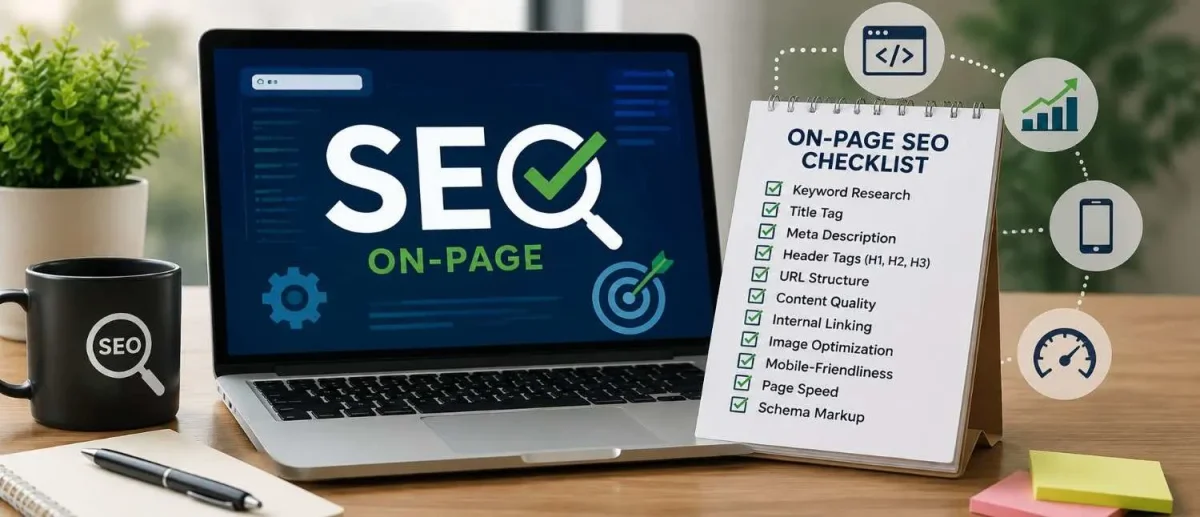
That control is also the trap. Because it is easy, it gets rushed, and rushed on-page work is the quiet reason strong content underperforms. A checklist turns a scattered task into a repeatable pass anyone on your team can run.
The payoff of a checklist is consistency at scale. When every page passes the same review, quality stops depending on who happened to build it, which is exactly what a growing content operation needs.
What on-page SEO actually covers
On-page SEO is every optimization made directly on a web page to help it rank and to help a visitor act. It spans the visible content, the underlying HTML, and the internal structure that connects one page to the next.
Unlike the other disciplines, it has no external dependency. There is no publisher to persuade and no crawler quirk to wait on, so it is the one area where a team can decide to improve a page and simply do it the same day.
It sits alongside two neighbors, and the split is clean:
- Off-page SEO earns authority from other domains through links and mentions.
- A technical SEO audit keeps the site crawlable, fast, and indexable.
- On-page SEO shapes what the page says and how clearly it says it.
That middle position is why on-page is the highest-leverage place to start. You do not have to wait for backlinks or a developer sprint. You can open the page, fix the intent and the tags, and publish, often seeing movement before the slower levers even begin to work.
The point is to serve the reader first, and the algorithm tends to follow. Google's Search Liaison, Danny Sullivan, framed the aim as being to "reward content made for people, not for search algorithms." On-page done well serves both at once.
Each discipline limits the others when it is weak, and on-page is the only one a team can strengthen entirely on its own, which is what makes it the natural first move.
Start with intent before keywords
Every optimized page begins with a single question: what does the searcher actually want? Match that intent, and the rest of the checklist compounds. Miss it, and no amount of tag polishing will save the page.
Read the current results for your target query before writing. If the page-one results are guides, a product page will struggle there. The format Google already rewards is a strong signal of the intent behind the search.
Intent also has a shape. A query like "best running shoes" wants a comparison, while "how to clean running shoes" wants a process. Build the page around that shape first, and every later checklist item has something solid to attach to.
Three quick checks confirm the intent before you write:
- Scan the page-one formats: guides, product pages, or videos signal what the query rewards.
- Read the titles that already rank to see the angle searchers respond to.
- Note the SERP features present, since a featured snippet or a shopping row hints at what the page must supply.
This matters because users are unforgiving with their attention. Nielsen Norman Group's eye-tracking research found that on an average page, people read at most 28% of the words. Lead with the answer, and earn the rest of the read.
The on-page SEO checklist, grouped by signal
With intent settled, work the page in four groups. Each group below is a checkpoint you can verify before publishing, so the review runs the same way every time and nothing important slips.
Content and keywords
The substance the page is built on. Get this wrong and the tags are decoration.
- Place the primary keyword in the first 100 words, naturally, so both readers and engines confirm the topic fast.
- Cover the subtopics the top results share, since matching that breadth signals the depth Google expects for the query.
- Answer the core question in the opening lines, then expand, so a scanner and a deep reader both leave satisfied.
- Add original data, firsthand examples, or a clear point of view, the elements commodity content and AI summaries cannot replicate.
- Refresh the page when facts age, because freshness is a genuine signal for queries where recency matters.
HTML tags and structure
The signals that tell engines what the page is about.
- Write one clear title tag under about 60 characters, with the primary keyword near the front where it carries the most weight.
- Craft a meta description that earns the click, since a higher click-through rate on a strong snippet compounds over time.
- Use exactly one H1, then logical H2s and H3s, so the heading outline reads like a table of contents for the page.
- Add descriptive alt text to every meaningful image, making it accessible, index-eligible, and eligible for image search.
Internal links and URLs
How the page connects to the rest of the site and passes authority.
- Keep URLs short, lowercase, and descriptive, with the keyword rather than parameters.
- Link out to related pages using descriptive anchors, the same discipline our white-label link building team applies off-page.
- Point a few internal links at the page from relevant existing content, so crawlers never treat it as an orphan.
- Add schema markup where the page type supports it, such as FAQ, product, or article.
Experience and readability
The signals that keep a visitor on the page long enough to convert.
The way people consume pages forces this. Nielsen Norman Group's studies show 79% of users scan rather than read, and only 16% move through a page word by word. Structure has to carry the meaning.
- Break copy into short paragraphs and use subheadings every few hundred words.
- Front-load each section so the scannable first line delivers the point.
- Keep the primary call to action visible without forcing a long scroll.
- Ensure the page is comfortable on mobile, since that is the version Google indexes first.
None of this is decoration. A page that answers the query, then makes the answer easy to scan and act on, is the version that holds attention long enough to rank and convert.
How to prioritize on-page fixes
A checklist with thirty items can paralyze a team as easily as it guides one. Not every item carries equal weight, so treating them as a flat list wastes effort on low-impact polish. Sort every page-level fix by the return it produces, then work top down.
- Fix intent mismatches first, because a page aimed at the wrong query cannot be tag-tuned into ranking.
- Rewrite weak titles and thin intros next, since they move clicks and early engagement fastest.
- Improve internal linking to your priority pages, a high-leverage move most teams skip.
- Layer in schema and alt text last, as valuable polish rather than the main event.
The pattern holds across the pages our team optimizes for agencies. Most of the ranking gain comes from a few high-intent fixes, while chasing every green checkmark on a plugin returns little. On-page rewards focus.
A useful rule is to fix the pages that already rank on page two before building new ones. They are the closest to a breakthrough, and a sharper title, a better intro, and a few internal links often move them onto page one faster than any fresh content could.
Where on-page connects to the wider program, the same discipline scales. Reading the gaps in a rival's pages through digital competitor analysis shows which on-page moves are worth making first.
That focus is also where capacity becomes the constraint. Running this pass across dozens of client pages every month is a delivery problem, which is why agencies route the execution to a partner like Pulse100x while they keep the strategy.
Common on-page SEO mistakes agencies inherit
Most underperforming pages already had real effort put into them. What holds them back is a short list of repeated errors that a checklist is built to catch. The same few show up across the pages our team rebuilds for agencies.
- Targeting a keyword without checking intent, so a thin blog post competes in a results page full of product pages.
- Stuffing the exact keyword repeatedly instead of covering the topic, which reads badly and no longer helps rankings.
- Writing a title for the algorithm rather than the click, leaving easy click-through gains on the table.
- Publishing an orphan page with no internal links pointing to it, so it looks unimportant to crawlers.
- Treating alt text and schema as busywork, then wondering why images and rich results never appear.
Clear these five and most pages improve before you touch anything else. On-page SEO rewards the disciplined pass far more than the clever trick, which is exactly why a repeatable checklist beats intuition.
On-page SEO and the shift to AI answers
The checklist now reaches well beyond blue links. AI Overviews and answer engines pull from the same on-page clarity that helps traditional rankings, so structured, intent-matched content compounds across both.
Clear headings, direct answers, and clean structure are what let a page be quoted by an AI system. A few on-page habits make a page easy to lift into an answer:
- A direct one or two sentence answer sitting right under the heading that asks the question.
- Descriptive headings that mirror how people phrase the query.
- Structured data and clean lists that machines can parse without guessing.
The overlap with answer engine optimization is large, and on-page discipline is the shared foundation.
Measurement ties it together. Tracking the right on-page outcomes through your digital marketing KPIs tells you which fixes moved rankings, clicks, and conversions, and which were cosmetic.
The practical takeaway is simple. On-page SEO is no longer a one-time optimization but a recurring pass tied to how search itself is changing. The teams that treat it as a habit, run quarterly on their priority pages, are the ones that hold rankings as the results page keeps shifting.
Ship on-page SEO at scale
Pulse100x runs white-label on-page SEO for agencies, so you keep the client relationship while we handle the page-by-page execution.