The Ecommerce Conversion Funnel: Stages, Leaks, and Fixes for 2026
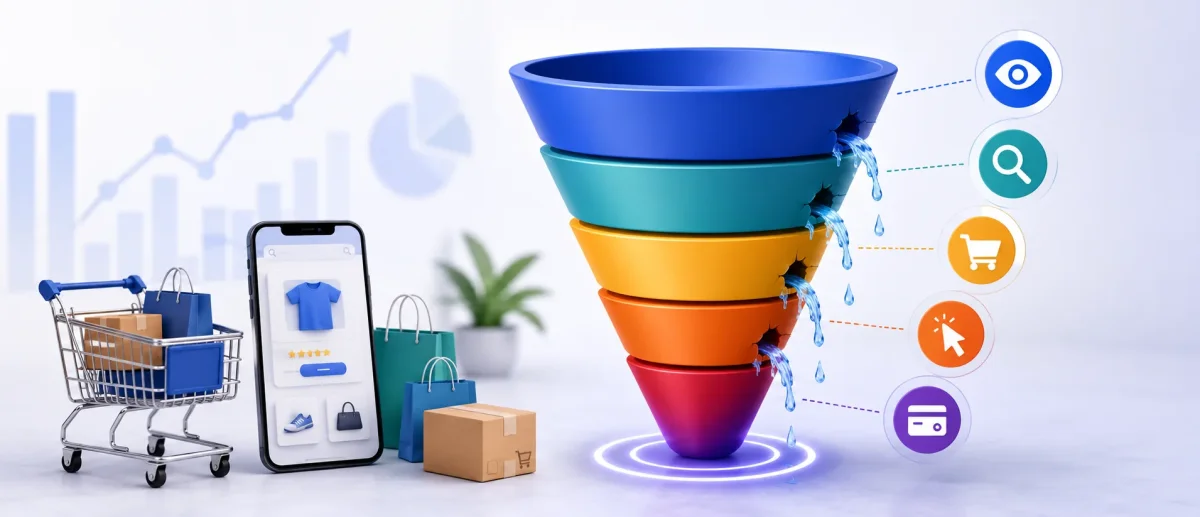
Most stores obsess over the very top, pouring budget into traffic while the checkout quietly leaks buyers who already wanted to purchase. Fixing the funnel often returns more than buying more visitors, because you are recovering demand you have already paid to create.
What is an ecommerce conversion funnel
An ecommerce conversion funnel is the path a shopper takes from first discovering a store to completing a purchase and, ideally, returning. It narrows at each step, since only a fraction of visitors move from one stage to the next.
The word funnel is literal. A wide pool of visitors enters at the top, and a narrow stream of buyers exits at the bottom, with predictable drop-offs between. Naming those drop-offs is what makes the funnel useful for fixing them.
The narrowing is steep, and the sharpest drop is near the end. The Baymard Institute, aggregating 50 studies, puts the average cart abandonment rate at 70.22%, meaning roughly seven of every ten shoppers who add to cart leave without buying.
The funnel shape matters because each stage multiplies against the next. A store that loses half its shoppers at three consecutive steps keeps only an eighth of them, so small improvements at several stages compound into a large gain in orders.
That single figure reframes the priority. A store obsessing over traffic while ignoring a 70% checkout leak is filling a bucket with a hole in it. Understanding each stage is how you find and patch the hole.
The funnel is also a diagnostic tool. When conversions dip, the stage-level view answers three questions fast:
-
Where shoppers arrive, which tests discovery and traffic quality.
-
Where they hesitate, which tests product pages and persuasion.
-
Where they leave, which usually points straight at checkout.
The stages of the ecommerce funnel
The funnel has four working stages. Each has a distinct job, a distinct shopper mindset, and a distinct set of reasons people drop out. Treating them as one blurred journey is the most common strategic error.
Awareness
The shopper discovers the store, often through search, social, or a product image that stops the scroll. Visual content does heavy lifting here, since a compelling image communicates faster than any description at the moment of discovery.
The cheapest awareness is the kind you do not pay for repeatedly. Ranking product and category pages in organic search turns discovery into a compounding asset, unlike paid traffic that stops the moment the budget does.
That reliance on the visual carries real weight. As AI systems learn to read images the way they read text, Fei-Fei Li's observation that "understanding vision and building visual systems is really understanding intelligence" points to how product imagery is increasingly indexed and surfaced.
Consideration
The shopper evaluates. They compare products, read reviews, check specifications, and weigh price against alternatives. The store's job is to answer objections and build enough confidence to move the shopper toward a decision.
This is where content earns its keep. Clear specifications, honest reviews, sizing help, and comparison guides remove the doubts that stall a purchase, so the shopper reaches checkout already convinced rather than still deciding.
Conversion
The shopper commits, adds to cart, and enters checkout. This is where the funnel leaks hardest, so friction here is the most expensive friction in the entire journey. Every extra field and surprise cost pushes buyers out.
The mindset here is fragile. A shopper at checkout has decided to buy, so anything that reintroduces doubt, a hidden fee, a forced account, a confusing form, can undo the decision in seconds. Protecting that moment is the highest-value work in the store.
Retention
The purchase opens the next cycle. Repeat buyers cost far less to sell to than new ones, so the funnel loops. Post-purchase email, support, and loyalty turn a single sale into a relationship that compounds.
Retention is the cheapest growth a store has. An existing customer already trusts you, already knows the checkout, and needs far less convincing, so every repeat order carries a fatter margin than the first one did.
Where ecommerce funnels leak, and how to fix them
Leaks follow patterns. Baymard's research catalogs the recurring reasons shoppers abandon, and most of them are fixable inside your existing store without buying more traffic.
The encouraging part is that these leaks are usability problems the store can fix. The shopper wanted the product enough to reach checkout, so closing the gap is a matter of removing friction, since the desire is already there.
|
Leak |
Why it happens |
Fix |
|
Surprise costs |
Shipping, fees, taxes appear late |
Show total cost upfront |
|
Forced account |
Signup required to buy |
Offer guest checkout |
|
Long checkout |
Too many form fields |
Cut fields, add autofill |
|
Weak trust |
No reviews or security cues |
Add proof and secure badges |
The biggest single leak is cost transparency. Baymard found that 48% of shoppers abandon because of unexpected extra costs at checkout, so surfacing the full price early is often the highest-return fix a store can make.
The scale of the opportunity is enormous. Baymard estimates that roughly 260 billion dollars in lost orders across the US and EU are recoverable through better checkout design alone, before a store spends a cent on new traffic.
Read that number against ad budgets and the priority flips. Most stores would find it cheaper to recover a slice of abandoned checkouts than to buy the equivalent revenue in new traffic, yet the traffic line usually gets the attention.
How to measure the ecommerce funnel
You cannot fix what you do not measure per stage. A single conversion rate hides where the real losses happen, so the funnel needs stage-level metrics that isolate each drop.
The overall conversion rate is a headline that hides where the loss happens. Two stores with identical rates can leak in completely different places, one at the product page and one at checkout, and only stage-level metrics tell them apart.
-
Product view rate shows whether awareness traffic reaches the products that matter.
-
Add-to-cart rate measures how well product pages convince shoppers to commit.
-
Checkout completion rate exposes the biggest leak, the gap between cart and purchase.
-
Repeat purchase rate tracks whether the retention loop is actually closing.
Fold these into your digital marketing KPIs so the funnel reports where revenue leaks, not just how many visitors arrived. Stage-level numbers turn a vague conversion problem into a specific, fixable one.
How to optimize each funnel stage
Optimization means matching the fix to the stage, since a checkout tweak does nothing for an awareness problem. Work each stage against its own specific failure mode.
-
At awareness, win discovery through organic search and strong product imagery, since traffic you do not pay for compounds.
-
At consideration, answer objections with reviews, clear specs, and comparison content that removes doubt before it stalls the sale.
-
At conversion, strip checkout friction, show full costs early, and offer guest checkout to recover the biggest leak.
-
At retention, use post-purchase email and loyalty to turn one order into many, lowering the cost of the next sale.
-
Across every stage, keep the site fast, since speed quietly protects conversion at each step and slow pages leak shoppers silently.
The discipline is to fix the leakiest stage first. Pouring more traffic into a funnel that loses 70% at checkout wastes the spend, while patching checkout lifts revenue from every visitor already arriving.
A simple order of operations helps. Measure each stage, find the steepest drop, fix it, then re-measure and move to the next. This loop turns optimization into a repeatable process instead of scattered, unrelated tweaks.
Testing keeps it honest. Small changes to product pages and checkout should be validated against real behavior, since intuition about what shoppers want is often wrong, and the data settles the argument faster than opinion.
Discovery still starts with being found. A clean technical SEO audit keeps product pages fast and crawlable, since a slow store leaks shoppers before the funnel even begins.
Where the funnel fits in the wider strategy
The conversion funnel is where marketing effort becomes revenue. Everything upstream, awareness, content, search, exists to feed it, and everything downstream depends on how cleanly it converts.
That is why it deserves shared ownership. Traffic teams, content teams, and developers all shape the funnel, so treating it as one connected system, instead of separate handoffs, is what stops shoppers slipping through the gaps between departments.
That makes it a strategy centerpiece, well beyond a checkout detail. Three connections anchor it to the wider plan:
-
A marketing strategy framework treats the funnel as the throughline connecting demand creation to demand capture across every channel.
-
A digital competitor analysis reveals how competitors handle discovery and checkout, exposing the stages where you lose shoppers you should keep.
-
Strong digital lead generation keeps qualified traffic flowing in, so the stage-level fixes have enough volume to matter.
Fix the leaks and convert more shoppers
Pulse100x runs white-label ecommerce SEO and conversion work for agencies, so you grow client revenue while we handle the discovery and funnel execution.