White Label SEO vs SEO Reseller: Key Differences That Actually Matter for Agencies
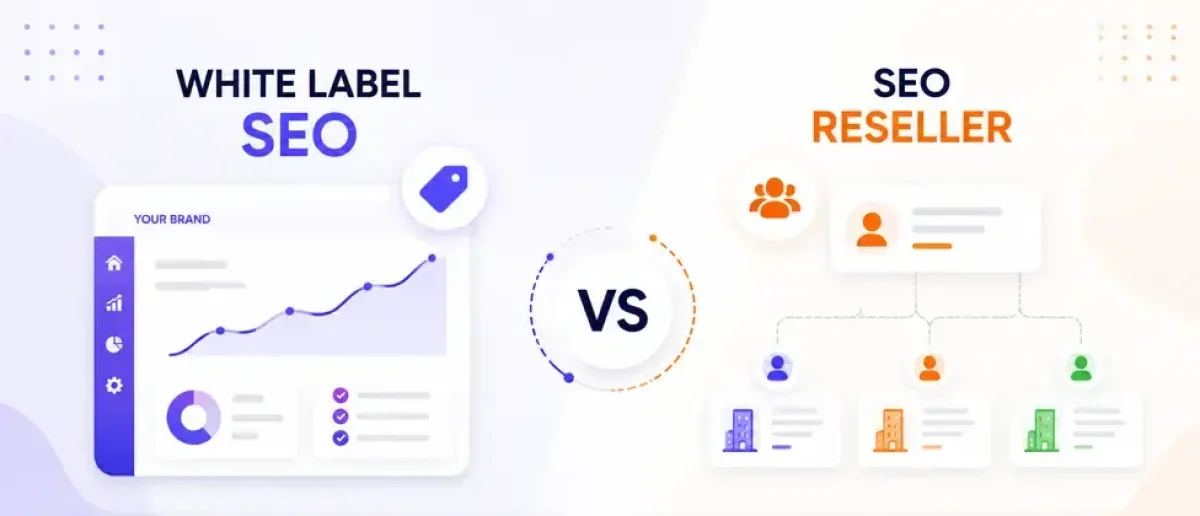
Agencies reach this question from the same starting point: SEO is on the table, building an in-house team is not the right move right now, and the choice is between two outsourced models that look similar on the surface.
White label SEO and SEO reseller programs both solve the fulfilment problem. Where they diverge is in how client relationships are structured, how margins behave over time, and what the agency is actually building toward.
What is white label SEO?
A specialist provider handles the execution. Your agency handles everything the client sees.
Deliverables, reporting dashboards, strategy documents, monthly performance reviews: all of it surfaces under your brand. The provider's name never reaches the client. What the client experiences is your agency's communication, your framing, your relationship.
The fulfilment layer stays invisible
Agencies that have run white label SEO across multiple verticals describe the model the same way. The work becomes background infrastructure. The relationship becomes the actual product. That is where retention lives, and where margin compounds over time.
What the provider actually handles
-
Technical audits and crawl optimisation
-
Topical authority mapping and content gap analysis
-
On-page optimisation across target URL clusters
-
Off-page authority building and link acquisition
-
Branded reporting delivered to your template
What is SEO reseller program?
A reseller program is a wholesale arrangement. The provider builds the packages, sets the delivery format, fixes the wholesale rate, and you mark up on resale. You are a distribution channel, not a brand wrapper. The strategic scope is fixed. The deliverable format belongs to the provider. In many programs, their reporting infrastructure or co-branded templates remain visible to your client.
White label SEO vs SEO Reseller: 5 differences that change how your agency operates
|
Factor |
White label SEO |
SEO reseller program |
|
Brand on deliverables |
Entirely yours |
Provider-visible or co-branded |
|
Pricing control |
You set the rate |
Capped by wholesale margin |
|
Strategy flexibility |
Tailored per client |
Fixed package tiers |
|
Client relationship |
Fully owned |
Partially mediated |
|
Client switching friction |
High |
Low |
The last row is what most comparisons avoid. Reseller programs create low switching friction not just for you changing providers, but for your client leaving you. When the infrastructure they interact with belongs to someone else, your agency's retention leverage weakens with every passing month.
Which model generates better margins
Gross margin benchmarks tell the story cleanly.
Agency Analytics data from 2023 put white label SEO agencies at 38 to 52 percent gross margin on SEO retainers. Reseller-model agencies came in at 18 to 28 percent. The entry cost for reseller programs is lower. The ceiling is structurally fixed by the wholesale rate and does not move regardless of how well you sell.
White label arrangements cost more to set up. The return scales with your positioning, your client relationships, and your ability to retain accounts long-term, none of which a reseller program touches.
What the outsourcing data shows
Most small and mid-size agencies have already made this decision.
The chart above reflects what agency growth practitioners have observed for years. White label arrangements dominate because they protect client relationships at scale. Reseller programs cluster at the entry end: freelancers and newer agencies validating SEO demand before committing to a deeper fulfilment partnership.
That is a legitimate use of the reseller model. Running it as a long-term operating structure for an agency building brand equity is where it starts to cost more than it saves.
Which model suits your agency right now
You should be on white label SEO if
-
You have active retainer clients and want SEO margin without adding headcount
-
Your clients span different verticals and fixed packages will leave gaps in delivery
-
You are positioning your agency as the expert, not the middleman
-
Retention and lifetime value are how you measure growth
A reseller program makes sense if
-
You are testing whether SEO converts in your existing client base
-
Volume is too low to justify vetting and onboarding a white label partner
-
You need to activate an offering in weeks, not months
Most agencies move off reseller programs within eighteen months. Not because the model fails. Because growth makes the ceiling visible.
Scale SEO delivery without scaling your team
Pulse100x operates as a white label SEO partner for agencies running engagements of any size, from a single local business client to multi-site enterprise accounts handled simultaneously. The fulfilment model does not change between them. The delivery quality does not tier by budget.
Your clients see your brand on every touchpoint. Pulse100x handles the execution across technical SEO, content, and off-page authority building. You set the margin, own the relationship, and scale without adding to your payroll.
Contact Pulse100x team about building a white label SEO offering that fits how your agency already operates.